
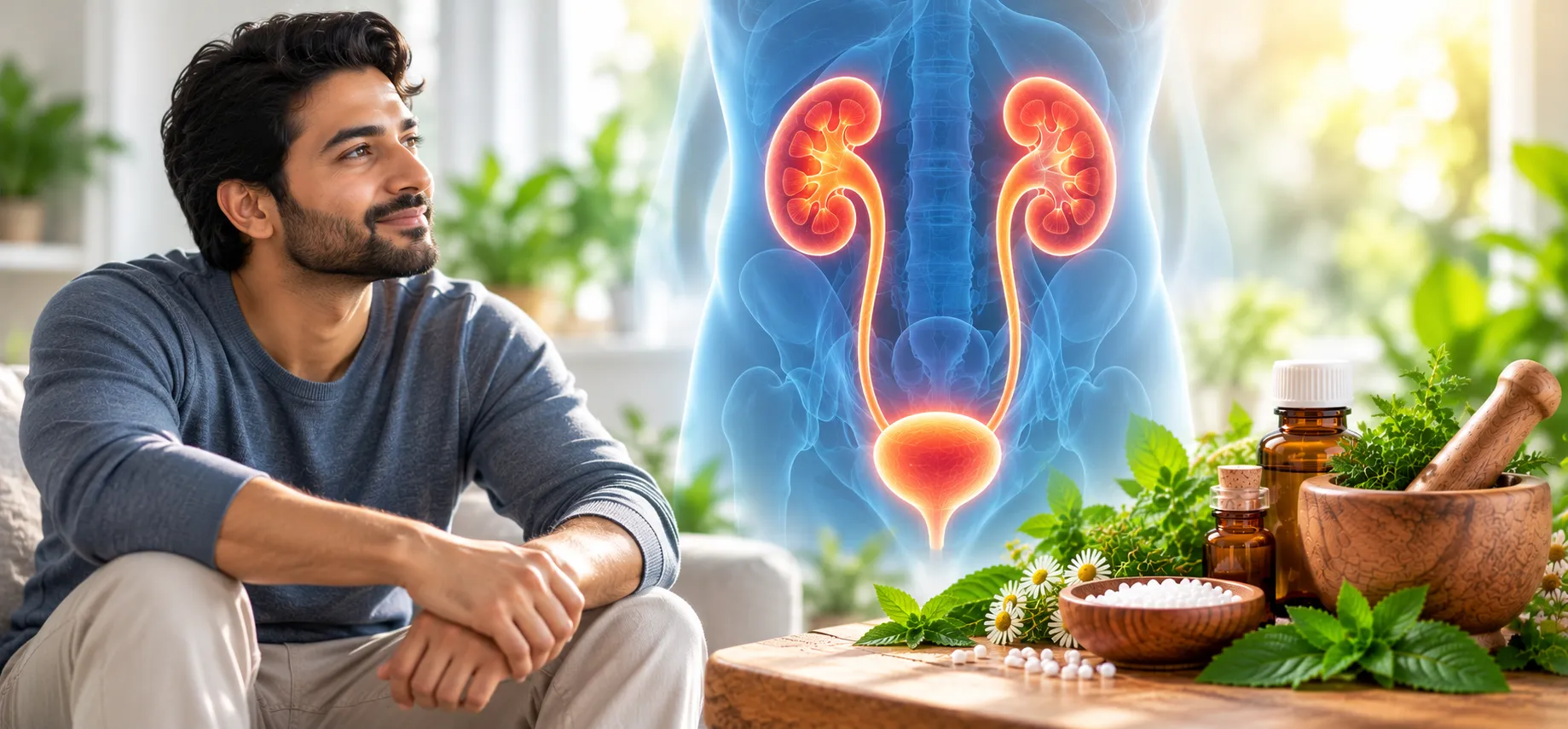
This guide lists homeopathic medicines that are commonly considered for urethral stricture, along with the symptom picture usually associated with each one. It is general information only: homeopathic prescribing is individualised, so the right medicine depends on your complete case – please consult a qualified homeopathic doctor before taking any of them, and do not stop or change any current treatment without medical advice.
Wondering which of these medicines is right for you?
Every person with urethral stricture is different, and so is the medicine that works best for them. To discover the best-suited homeopathic medicines for urethral stricture for you, consult our experts. They will study your symptoms, your past treatment history and your personality, and then find the homeopathy medicines that suit you best.
Call +91 8080 850 950 for a 1:1 personal consultation with our experts today.
About urethral stricture
A urethral stricture is a narrowing of the urethra, the tube that carries urine out of the bladder, caused by scar tissue. It can follow an injury to the groin or pelvis, a urinary or sexually transmitted infection, catheterisation or instrument procedures, previous surgery or radiation, or inflammatory skin conditions. A weak or spraying urine stream, straining to pass urine, a feeling of incomplete emptying, dribbling after urination, frequent urinary infections and pain are the usual signs. Diagnosis involves a flow-rate test, an X-ray study of the urethra (urethrogram) and sometimes a look inside with a small camera. Treatment is usually procedural – dilatation, a small internal cut or reconstructive surgery by a urologist – and strictures can come back, so follow-up is important. Being unable to pass urine at all is an emergency and needs immediate hospital care. Homeopathic treatment is supportive and does not replace urological treatment.
Homeopathic medicines for urethral stricture
(1) Clematis erecta: Traditionally considered for stricture with a slow, interrupted or dribbling stream, drops of urine passing after urination and sensitivity of the urethra.
(2) Thuja occidentalis: Stricture with a history of urinary or sexually transmitted infection, a split or forked stream and a burning or cutting sensation while passing urine.
(3) Sarsaparilla: Pain at the end of urination, with scanty flow, gravel or sand in the urine and urine passed only with difficulty while sitting.
(4) Cantharis: Intense burning and scalding pain with a constant urge, and urine passed in drops with straining.
(5) Pareira brava: Great straining and urging, with urine passing only when the person bends forward, and pain extending down the thighs.
(6) Silicea: Considered where scarring and hardening of tissue are prominent, in chilly, sensitive people who heal slowly.
(7) Conium maculatum: A stream that starts and stops, with a feeling of being unable to empty the bladder, often in older men.
(8) Causticum: Weak bladder control, difficulty passing urine or inability to pass urine for long, with weakness and chilliness.
(9) Staphysagria: Urethral irritation and burning after catheterisation, instrumentation or intercourse, in sensitive people with suppressed emotions.
(10) Berberis vulgaris: Burning and cutting pain in the urethra with frequent urging, and pain that radiates to the loins and thighs.
Homeopathic treatment of urethral stricture at Welling Homeopathy
These are only basic indications – many more homeopathic medicines are used for urethral stricture, and the right one is chosen after detailed case-taking by an experienced doctor. To find out about homeopathy treatment of urethral stricture at Welling Homeopathy, contact a Welling clinic or call +91 80 80 850 950 for a consultation in person or online.
Learn more
Disclaimer: this page is for information only and is not a substitute for professional medical advice, diagnosis or treatment. Results vary from person to person.
