
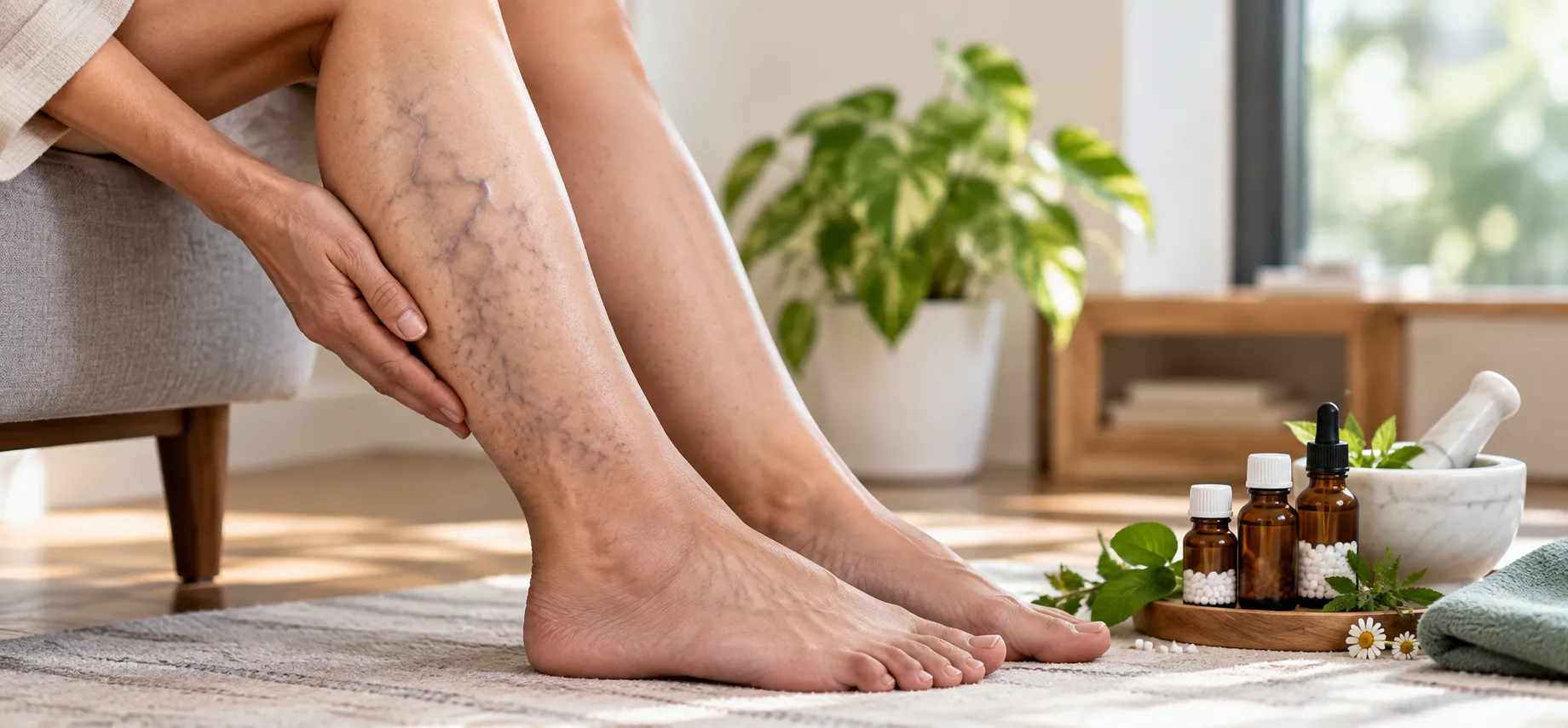
Varicose veins are something I see quite often in my practice. Some people come because they are worried about the veins becoming more prominent. Others come because their legs feel heavy, painful or swollen, especially towards the end of the day.
And there is one question I hear regularly:
“Is there any homeopathy medicine for varicose veins?”
The answer needs a little explanation.
Homeopathy can be considered as part of an individualised approach to managing the symptoms associated with varicose veins. But varicose veins are not simply a problem of the skin. They are related to the way blood returns through the veins of the legs. So the severity of the condition, the symptoms, circulation and the possibility of complications all need to be considered before deciding on treatment.
In this article, I will explain what varicose veins are, what symptoms to watch for, how homeopathy is approached at Welling Homeopathy, and when you should see a vascular specialist.
What are varicose veins?
Varicose veins are enlarged, twisted veins that usually appear on the legs. They may look blue, purple or skin-coloured and can appear raised or rope-like beneath the skin.
Normally, veins carry blood back towards the heart. The veins in the legs have to work against gravity. Small valves inside the veins help prevent blood from flowing backwards.
When these valves do not work properly, some blood can collect in the veins. Over time, the veins may become enlarged and visible.
This is why varicose veins are more than just a cosmetic problem for some people.
They can be associated with:
- Aching or pain in the legs
- A feeling of heaviness or tiredness
- Swelling around the ankles
- Burning or throbbing
- Muscle cramps
- Itching around the affected veins
- Skin colour changes
- Symptoms that become worse after prolonged standing
The symptoms may improve when you rest and raise your legs.
Why do some people develop varicose veins?
There is usually no single reason.
Age is one factor because the vein valves can become less efficient over time. Family history can also play a role.
Other factors may include:
- Spending many hours standing
- Being overweight
- Pregnancy
- Increasing age
- A family history of varicose veins
- Previous problems with the veins
- Lack of regular physical activity
This is also why two people with apparently similar-looking veins may have very different symptoms.
One person may have prominent veins without much discomfort. Another may have relatively small visible veins but considerable aching and swelling.
That difference is important when deciding on treatment.
What is the best homeopathy medicine for varicose veins?
There is no single homeopathic medicine that is right for every person with varicose veins.
This is one area where I would strongly advise against choosing a remedy simply from a list on the internet.
In homeopathy, the choice of medicine is traditionally based on the complete symptom picture rather than the diagnosis alone.
For example, a homeopathy doctor may look at:
- Where the pain is located
- Whether there is heaviness or burning
- Whether the veins are tender
- Whether symptoms become worse after standing
- Whether movement helps or aggravates the symptoms
- Whether swelling is present
- The time of day when symptoms are worse
- The person’s general health
- Previous medical history
- Other symptoms occurring at the same time
This is why the same diagnosis can lead to different homeopathic prescriptions in different people.
Homeopathic medicines traditionally considered for varicose vein symptoms
Some medicines commonly discussed in homeopathic practice include Hamamelis virginiana, Pulsatilla, Aesculus hippocastanum, Vipera berus, Calcarea fluorica and Fluoric acid.
However, these should not be treated as a universal list of “best medicines”.
For example, Hamamelis has traditionally been considered when there is marked soreness or tenderness associated with venous symptoms. Aesculus is traditionally considered when there is a feeling of heaviness or aching. Pulsatilla may be considered when the overall symptom picture matches the remedy.
The important point is that the medicine is selected according to the individual symptoms, rather than simply because someone has varicose veins.
I would also make an important distinction here.
There is not strong clinical evidence showing that homeopathic medicines can repair damaged venous valves or reliably eliminate established varicose veins. Therefore, homeopathy should not be presented as a replacement for appropriate vascular assessment or proven procedures when these are indicated.
Can homeopathy help with varicose vein symptoms?
This is a more useful question than simply asking whether a particular medicine can “cure” varicose veins.
Some people seek homeopathy because they want help with symptoms such as heaviness, aching, discomfort or swelling. An individualised homeopathic consultation may be considered as part of their overall care.
At the same time, I believe patients should understand what homeopathy can and cannot realistically be expected to do.
If there is significant venous insufficiency, a large varicose vein, an ulcer, bleeding or a suspected blood clot, proper medical assessment is important.
Conventional treatment for varicose veins can include compression therapy and procedures such as endovenous ablation or sclerotherapy. The appropriate option depends on the person’s condition and assessment.
Homeopathy and varicose veins at Welling Homeopathy
At Welling Homeopathy, we don’t believe in giving the same medicine to every person who walks in with varicose veins.
During a consultation, our experts try to understand the person behind the diagnosis.
We look at the history of the problem, the nature of the pain or discomfort, the pattern of swelling, factors that make the symptoms better or worse, lifestyle and other health concerns.
The aim is to create an individualised treatment plan rather than simply prescribe a medicine because the patient has been diagnosed with varicose veins.
This approach is particularly important in chronic conditions, where the symptoms may have been present for several years.
What can you do at home for varicose veins?
Treatment does not begin and end with medicine.
Simple lifestyle measures can make a meaningful difference to symptoms.
1. Keep moving
Regular walking and physical activity help the muscles of the legs assist blood flow.
If your work involves sitting or standing for long periods, try to change position and move around regularly.
2. Raise your legs
If your legs feel heavy or swollen towards the end of the day, resting with your legs elevated may help reduce discomfort and swelling.
3. Maintain a healthy weight
If you are carrying excess weight, gradual weight reduction can reduce pressure on the veins and may make symptoms easier to manage.
4. Avoid standing or sitting in one position for too long
This is particularly relevant for people whose jobs require them to stand for several hours.
Small movements throughout the day are better than remaining in exactly the same position for long periods.
5. Ask about compression stockings
Compression stockings can help some people with swelling and discomfort. However, they are not appropriate for everyone, particularly people with certain problems affecting arterial blood flow.
It is better to ask a doctor or qualified healthcare professional about the appropriate type before using them.
Can varicose veins disappear with homeopathy?
I would be careful with anyone who promises that a homeopathic medicine will make every varicose vein disappear.
Established varicose veins are related to changes in the veins and their valves. Treatment should therefore depend on the underlying problem.
Some people mainly need symptom management and observation. Others may need compression treatment or a vascular procedure.
Homeopathy may be explored by people who prefer an individualised complementary approach, but it should not delay appropriate diagnosis or treatment when there are warning signs.
When should you see a doctor?
Varicose veins are often not dangerous, but certain symptoms should not be ignored.
Seek medical assessment if you develop:
- Sudden or significant swelling of one leg
- Severe or new leg pain
- A vein that becomes hard and very painful
- Bleeding from a varicose vein
- Skin ulcers, particularly around the ankle
- Significant skin colour changes
- Sudden worsening of symptoms
A duplex or Doppler ultrasound may be used when a specialist needs to assess blood flow and the condition of the veins.
If you develop sudden leg swelling or pain, especially if accompanied by breathlessness or chest pain, seek urgent medical care rather than trying to treat it yourself.
Frequently Asked Questions
Which homeopathy medicine is best for varicose veins?
There is no single best homeopathic medicine for everyone with varicose veins. Medicines such as Hamamelis, Aesculus, Pulsatilla and others are traditionally used in homeopathic practice, but the choice depends on the individual’s symptoms and overall case.
Can homeopathy cure varicose veins permanently?
It would not be medically responsible to promise a permanent cure for established varicose veins with homeopathy. Varicose veins can involve structural problems with the veins and their valves. A proper assessment is important, particularly when symptoms are significant.
Is homeopathy safe for varicose veins?
A homeopathic consultation itself should not replace medical evaluation. The main concern is not simply the medicine. It is making sure that a potentially serious vascular problem is not missed because someone is relying only on home treatment.
Can I take homeopathy along with other treatment?
This depends on the treatment and your individual medical situation. Tell your doctor about all medicines and treatments you are using. If you are already under the care of a vascular specialist, do not stop prescribed treatment without discussing it with them.
Does exercise make varicose veins worse?
For most people, appropriate regular activity such as walking is helpful for blood flow and general leg health. The right level of exercise depends on the individual’s condition and symptoms.
My advice if you have varicose veins
Don’t look for a medicine based only on the name of the disease.
Look at the whole picture.
How long have you had the veins? Are they painful? Do your legs become heavy in the evening? Is there swelling? Does standing make things worse? Have the veins changed recently? Are there skin changes?
These details matter.
If you are considering homeopathy for varicose veins, speak to a qualified homeopathy doctor who can assess your symptoms properly. And if there are signs suggesting significant venous disease, get the appropriate vascular assessment rather than delaying it.
At Welling Homeopathy, our experts take an individualised approach to chronic conditions such as varicose veins. We first try to understand your symptoms and medical history and then decide whether homeopathic treatment is appropriate for you.
If you are looking for homeopathy treatment for varicose veins, you can speak to our experts at Welling Homeopathy.
Call +91 80 80 850 950 to book a consultation.