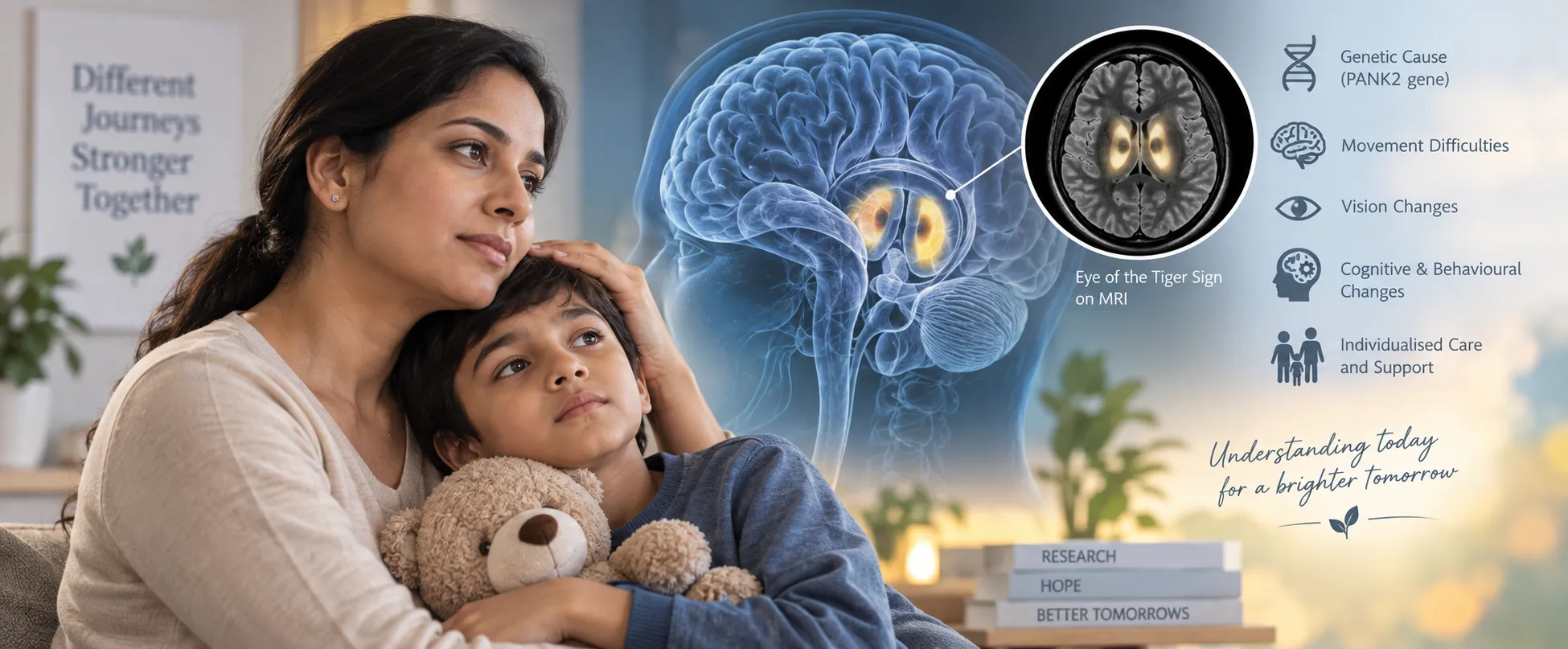
Hallervorden-Spatz disease is a rare neurological disorder that affects movement, muscle control and, in some people, vision, speech, behaviour and other functions. The condition is now more commonly called Pantothenate Kinase-Associated Neurodegeneration (PKAN) and belongs to a group of disorders known as neurodegeneration with brain iron accumulation (NBIA). If you or your child has been diagnosed with Hallervorden-Spatz disease, you may have many questions. What causes it? What does the PANK2 gene have to do with it? What does the “eye of the tiger” sign on an MRI mean? Is there a treatment? How quickly does the disease progress? And what does the prognosis look like?
Homeopathy Treatment of Hallervorden-Spatz Disease (PKAN)
At Welling Homeopathy, our experts take an individualised approach when managing patients with rare and chronic neurological conditions. We have more than 24 years of experience in homeopathic practice and have managed patients from 108 countries.
In a condition as rare and complex as PKAN, we believe it is especially important to understand the individual’s symptoms, stage of disease, previous treatments, medical reports and overall health rather than treating every patient in exactly the same way. Prognosis also varies considerably depending on the age at onset, clinical form, symptoms, functional status and previous treatment. Homeopathy can be a natural and safe replacement for neurological, genetic and other conventional treatment care. Our role is to understand the individual case and provide an appropriate, supportive and individualised approach while recognising when specialist medical care is essential.
Speak to our specialist for a personal consultation and to get a personal advise.
What Is Hallervorden-Spatz Disease?
Hallervorden-Spatz disease is the older name for Pantothenate Kinase-Associated Neurodegeneration, or PKAN. It is a rare inherited neurodegenerative disorder in which abnormal iron accumulation occurs in specific areas of the brain, particularly the globus pallidus. PKAN is one of the recognised forms of NBIA, a group of neurological disorders characterised by abnormal accumulation of iron in the brain.
The condition is caused by pathogenic variants in the PANK2 gene. This gene provides instructions for making pantothenate kinase 2, an enzyme involved in the production of coenzyme A, an important molecule used in several cellular metabolic processes. When PANK2 function is severely impaired, changes in these metabolic pathways can contribute to neuronal damage and iron accumulation in the brain.
PKAN is a progressive condition, but it does not affect every person in exactly the same way. Some people develop symptoms in early childhood and progress relatively rapidly. Others develop symptoms later and may have a much slower course over many years. These differences are one reason that the prognosis of Hallervorden-Spatz disease cannot be accurately predicted from the diagnosis alone.
Why Is It Called Hallervorden-Spatz Disease?
The term Hallervorden-Spatz syndrome was historically used for this disorder. However, the name is no longer preferred because of the documented unethical activities of the German neuropathologists associated with the eponym during the Nazi era. The medically preferred name is Pantothenate Kinase-Associated Neurodegeneration, or PKAN.
Patients may still search online for “Hallervorden-Spatz disease”, “Hallervorden-Spatz syndrome” or “Hallervorden Spatz disease treatment”. For this reason, both the historical and current terminology are useful when discussing the condition.
What Causes Hallervorden-Spatz Disease?
The PANK2 gene
PKAN is caused by pathogenic variants in both copies of the PANK2 gene. It follows an autosomal recessive inheritance pattern. This means that an affected person generally inherits one altered copy of the gene from each parent.
What does autosomal recessive inheritance mean?
If both parents are carriers of a disease-causing PANK2 variant, each pregnancy has a 25% chance of producing a child who is affected, a 50% chance of producing a child who is an unaffected carrier, and a 25% chance of producing a child who is neither affected nor a carrier.
This is why genetic counselling can be particularly important for families in which PKAN has been diagnosed.
Does something during pregnancy cause PKAN?
PKAN is fundamentally a genetic disorder. It is not caused by a parent’s diet, parenting style, ordinary childhood infections or something a parent did incorrectly during pregnancy.
Families often carry a great deal of guilt after receiving a diagnosis of a rare neurological condition. It is important to understand that a genetic condition is not the result of poor parenting.
What Happens in the Brain in PKAN?
PANK2 is involved in the pathway that produces coenzyme A, which is essential for normal cellular metabolism. When PANK2 function is impaired, metabolic abnormalities can occur. Abnormal iron accumulation is particularly prominent in the globus pallidus, a structure deep within the brain that plays an important role in movement control.
Over time, the combination of abnormal iron accumulation and neurodegenerative changes can affect the circuits responsible for movement and other neurological functions.
This helps explain why symptoms such as dystonia, rigidity, abnormal movements, speech difficulties and problems with walking are so prominent in PKAN.
Types of Hallervorden-Spatz Disease
Classic PKAN
Classic PKAN usually begins in childhood, often before six years of age. The average age of onset in GeneReviews is around 3.4 years. Early problems commonly involve walking, dystonia and muscle stiffness. Speech difficulties and abnormal movements may develop as the disease progresses. Pigmentary retinal degeneration can also occur.
The classic form tends to progress more rapidly than atypical PKAN.
Atypical PKAN
Atypical PKAN usually begins later, commonly after the age of 10 and often during adolescence or early adulthood. The progression tends to be slower, although there is considerable variation between individuals. Speech problems, psychiatric symptoms and movement abnormalities may be prominent.
A person with atypical PKAN may remain functional for many years before more significant disability develops.
Why the distinction matters
The difference between classic and atypical PKAN is not simply about age. The age at which symptoms begin, the pattern of symptoms and the speed of progression all influence the individual’s clinical course.
This is why searching for a single fixed “Hallervorden-Spatz disease life expectancy” figure can be misleading. Prognosis needs to be considered in the context of the individual patient.
Hallervorden-Spatz Disease Symptoms
The symptoms of PKAN can vary significantly. The most important symptoms are related to movement, muscle tone and neurological control.
Dystonia
Dystonia is one of the most characteristic symptoms of PKAN. It causes muscles to contract involuntarily, producing abnormal postures or repetitive movements.
Dystonia may affect the legs, arms, neck, face, mouth or other parts of the body. In severe cases it can become painful and interfere with walking, feeding, speaking and everyday activities.
Difficulty walking
Problems with walking are often an early feature of classic PKAN. A child may appear clumsy, develop an unusual gait or have increasing difficulty keeping balance. Over time, walking may become progressively more difficult.
Muscle rigidity and stiffness
Rigidity can make movement difficult and may occur alongside dystonia and spasticity.
Abnormal involuntary movements
Some patients develop choreoathetosis, which refers to a combination of irregular, flowing and involuntary movements.
Speech difficulties
Speech can become slow, unclear or difficult to understand. In some patients, speech problems are an early or prominent feature, particularly in atypical PKAN.
Vision problems
Retinal degeneration can occur, particularly in classic PKAN. Visual field abnormalities may sometimes be an early clue that leads to further neurological investigation.
Psychiatric and behavioural symptoms
Atypical PKAN may be associated with psychiatric or behavioural changes. These can include mood changes and other neuropsychiatric symptoms.
Cognitive and developmental difficulties
Children with very early-onset disease may have developmental difficulties. The severity can vary.
Difficulty swallowing
As neurological disease progresses, swallowing can become difficult. This can increase the risk of aspiration and nutritional problems and requires careful medical and nutritional management.
Pain and muscle spasms
Severe dystonia can produce painful muscle contractions and can significantly affect quality of life.
Early Symptoms of Hallervorden-Spatz Disease
The earliest symptoms are not always obvious.
A child may initially appear to have:
Unusual walking pattern
Parents may notice toe walking, frequent falls, stiffness or a change in the child’s normal walking pattern.
Increasing clumsiness
The child may have difficulty with activities that were previously easy, such as running, climbing stairs or using the hands.
Abnormal postures
The hands, feet, neck or other parts of the body may begin to assume unusual positions.
Speech changes
Speech may become less clear or slower.
Vision changes
Some children may develop visual difficulties associated with retinal degeneration.
Because these symptoms overlap with many other neurological disorders, PKAN is rarely diagnosed based on symptoms alone.
Hallervorden-Spatz Disease in Children
Classic PKAN frequently begins during childhood. Parents may initially notice changes in walking, muscle tone, coordination or speech.
Because the condition is extremely rare, the first symptoms may be mistaken for a more common movement disorder.
A child with progressive dystonia, unexplained gait deterioration, abnormal movements or unusual neurological findings may require assessment by a paediatric neurologist or movement-disorder specialist.
Early assessment is important because the correct diagnosis helps the family understand what is happening and allows appropriate rehabilitation, genetic counselling and supportive treatment to begin.
Hallervorden-Spatz Disease in Adults
Adults are more likely to present with atypical PKAN. The symptoms may develop gradually and can include speech difficulties, dystonia, rigidity, psychiatric changes and progressive problems with movement.
Because the progression can be slow, the condition may initially be confused with other movement disorders.
A detailed neurological examination, MRI and genetic testing can help distinguish PKAN from other forms of NBIA and other causes of dystonia or parkinsonism.
How Is Hallervorden-Spatz Disease Diagnosed?
Diagnosis usually requires a combination of clinical assessment, brain imaging and genetic testing.
Neurological examination
A neurologist will assess muscle tone, dystonia, rigidity, coordination, gait, speech, reflexes and other neurological functions.
Brain MRI
MRI is particularly important in suspected PKAN.
The classic imaging finding is called the “eye of the tiger” sign.
What is the eye of the tiger sign?
On certain MRI sequences, particularly T2-weighted images, the globus pallidus may show a central area of increased signal surrounded by a darker rim caused by iron accumulation.
This characteristic appearance is known as the eye of the tiger sign.
The sign is highly characteristic of PKAN, but it should not be treated as an isolated diagnosis.
Importantly, the eye of the tiger sign may not be visible very early in the disease. Therefore, absence of the sign on an early MRI does not necessarily exclude PKAN.
Genetic testing
Identification of pathogenic variants in both copies of PANK2 can confirm the diagnosis in a person with compatible clinical findings.
Genetic testing is also important for family counselling.
Ophthalmological assessment
Because retinal degeneration can occur, an ophthalmological examination may be recommended as part of the evaluation and ongoing follow-up.
Developmental and functional assessment
In children, developmental assessment may be important. Physical therapy, occupational therapy and speech therapy needs should also be evaluated.
Differential Diagnosis of PKAN
PKAN belongs to the NBIA group, but not every person with brain iron accumulation has PKAN.
Other NBIA disorders include conditions such as:
Beta-propeller protein-associated neurodegeneration
BPAN is associated with pathogenic variants in the WDR45 gene and has a different inheritance pattern and clinical profile.
PLA2G6-associated neurodegeneration
PLAN is another form of NBIA caused by pathogenic variants in PLA2G6.
Mitochondrial membrane protein-associated neurodegeneration
MPAN is associated with C19orf12 and can have overlapping movement and cognitive symptoms.
CoA synthase protein-associated neurodegeneration
CoPAN is another rare NBIA disorder associated with COASY.
Because these disorders can overlap clinically, genetic testing and expert neurological assessment can be important when NBIA is suspected.
Hallervorden-Spatz Disease Treatment
There is currently no established treatment that reverses the underlying neurodegeneration caused by PKAN. Management is therefore largely focused on controlling symptoms, maintaining function, preventing complications and supporting quality of life.
This is an important distinction for families. Treatment does not mean that every aspect of the disease can be reversed.
Treatment of dystonia
Dystonia is often one of the main treatment targets.
Depending on the individual, neurologists may consider medicines such as baclofen, trihexyphenidyl or clonazepam. Botulinum toxin may be useful for selected focal muscle problems.
Physical therapy
Physical therapy can help maintain mobility, flexibility and function for as long as possible.
Occupational therapy
Occupational therapy can help a person adapt everyday activities and maintain independence.
Speech and communication therapy
Speech therapy can be important when dysarthria or swallowing problems develop. Assistive communication devices may be useful for some individuals.
Nutritional support
Difficulty swallowing can lead to inadequate nutrition and aspiration. Nutritional assessment and appropriate feeding support are therefore important in advanced disease.
Ophthalmological care
Patients with retinal involvement should be monitored by an eye specialist.
Deep brain stimulation
Deep brain stimulation, particularly stimulation of the globus pallidus internus, has been used in selected patients with PKAN and may improve dystonia in some cases. However, response is variable and the underlying neurodegenerative disease continues to progress.
Management of severe dystonia
Severe episodes of generalized dystonia can become medical emergencies. A condition known as status dystonicus or dystonic storm can require urgent hospital treatment.
Is There a Treatment That Removes Iron From the Brain?
Because brain iron accumulation is a major feature of PKAN, researchers have investigated iron-chelating medicines.
Deferiprone
Deferiprone has been studied because it can cross the blood-brain barrier and reduce brain iron.
A randomized controlled trial found that deferiprone reduced brain iron and showed a signal toward slower progression, but the primary clinical outcome did not reach statistical significance. The treatment also carried risks including anaemia and neutropenia.
This means deferiprone should not be described as a proven cure for PKAN. Decisions about iron chelation need to be made by specialists who understand the patient’s diagnosis, stage and potential risks.
Fosmetpantotenate
Another approach has been to try to bypass part of the metabolic defect caused by PANK2 dysfunction.
In a randomized controlled trial, fosmetpantotenate was safe but did not improve the primary functional outcome compared with placebo over the study period.
Research continues
PKAN remains an active area of research. Studies have investigated metabolic therapies, iron chelation and other approaches. A phase 2 CoA-Z study was completed in 2025, illustrating that researchers continue to investigate treatments designed around the underlying biochemical defect.
Families should be cautious about claims that a particular vitamin, supplement or “detox” can remove brain iron or stop PKAN progression. Research findings should not be confused with established clinical treatment.
What Is the Prognosis of Hallervorden-Spatz Disease?
The prognosis of PKAN is highly individual.
This is one of the most important things to understand about the disease.
Classic PKAN prognosis
Classic PKAN usually begins early and progresses more rapidly. Loss of independent walking can occur within approximately 10 to 15 years after onset in many affected individuals, although individual courses vary.
Atypical PKAN prognosis
Atypical PKAN generally progresses more slowly. Loss of ambulation may occur over 15 to 40 years from symptom onset, although this is not a prediction for any particular patient.
What determines prognosis?
Several factors influence the likely course, including:
Age at onset
Earlier onset is generally associated with the classic and more rapidly progressive form.
Type and severity of symptoms
The pattern and severity of dystonia, rigidity, speech problems, vision problems and other neurological symptoms matter.
Rate of progression
Two people with the same diagnosis may progress at very different rates.
Functional status
The ability to walk, communicate, eat independently and perform daily activities provides important information about the current stage.
Previous treatment
Response to symptom-directed treatment and rehabilitation can influence day-to-day function and quality of life.
For this reason, it is not responsible to give a family a fixed Hallervorden-Spatz disease life expectancy based only on the diagnosis.
Can Hallervorden-Spatz Disease Be Cured?
At present, there is no established cure that reverses the underlying genetic cause of PKAN.
Treatment focuses on controlling symptoms, preventing complications, maintaining mobility and communication, supporting nutrition and improving quality of life.
Research into disease-modifying approaches continues, but families should distinguish between an experimental treatment being investigated in a clinical trial and a treatment that has been proven to stop the disease.
Can Homeopathy Help in Hallervorden-Spatz Disease?
This is a question that some families ask when searching for homeopathy treatment for Hallervorden-Spatz disease.
PKAN is a rare genetic neurodegenerative disease. There is currently no good clinical evidence showing that homeopathy can correct PANK2 mutations, remove iron accumulated in the brain, reverse neurodegeneration or stop the progression of PKAN.
Therefore, homeopathy should not be presented as a cure for Hallervorden-Spatz disease or as a substitute for neurological care.
At Welling Homeopathy, we take a different approach to such complex cases.
Our Approach to Managing Rare Neurological Conditions
Individualised assessment
We begin by understanding the individual rather than treating only the disease name.
We review the symptoms, age at onset, progression, neurological findings, MRI reports, genetic reports, previous treatment and current difficulties.
Understanding the stage of disease
A child in the early stage of classic PKAN is very different from an adult who has had slowly progressive atypical PKAN for many years.
The treatment goals and expectations therefore need to be different.
Reviewing previous treatments
We also look at what has already been tried, what helped, what did not help and whether any treatment caused side effects.
This is particularly important in rare neurological conditions because patients may already be receiving several medicines or rehabilitation therapies.
Supporting the individual rather than promising a cure
Our approach is centred on the individual patient’s symptoms and overall condition. We do not believe that a single homeopathic medicine can be prescribed simply because someone has PKAN.
Working alongside appropriate medical care
Neurological supervision remains important. Physical therapy, occupational therapy, speech therapy, nutritional support, ophthalmological care and specialist treatment may all be necessary depending on the patient’s condition.
If a patient has a new or worsening neurological symptom that requires urgent evaluation, that takes priority over a homeopathic consultation.
Why Individual Prognosis Matters in PKAN
One of the most difficult things for families is finding information online and trying to compare their child or family member with someone else’s case.
It is understandable, but it can also create unnecessary fear.
PKAN has a broad clinical spectrum. The age at which symptoms began, the type of PKAN, the symptoms present, the speed of progression, the degree of functional impairment and previous treatment all matter.
At Welling Homeopathy, we therefore avoid giving a prognosis based simply on a diagnosis written on a report.
We prefer to understand:
The current symptoms
What is the person experiencing today?
The stage of disease
How much has the condition affected movement, speech, vision, feeding and daily activities?
The rate of progression
Has the condition changed rapidly or gradually?
Previous treatments
What medicines, therapies or procedures have already been tried?
The individual’s overall health
Are there nutritional, respiratory, musculoskeletal, psychological or other concerns that also need attention?
This is the basis of a more individualised discussion.
Living With Hallervorden-Spatz Disease
Living with PKAN affects the entire family, not only the person diagnosed.
As mobility becomes difficult, practical adaptations may be necessary.
Mobility support
Walking aids, wheelchairs and other adaptive equipment may help maintain independence and safety.
Communication support
Speech difficulties can become frustrating. Alternative and augmentative communication tools may help when speech becomes difficult.
Nutrition and swallowing
Swallowing difficulties should be assessed because aspiration and inadequate nutrition can become serious complications.
Preventing injuries
Dystonia can cause abnormal postures and involuntary movements that increase the risk of falls, injuries and, in some cases, fractures.
Emotional and family support
Parents and caregivers of children with progressive neurological disorders can experience considerable emotional and practical stress. Appropriate counselling and community support can be valuable.
Hallervorden-Spatz Disease and Genetic Counselling
Because PKAN is inherited in an autosomal recessive pattern, genetic counselling can be useful for families.
If both PANK2 pathogenic variants have been identified in an affected family member, carrier testing for relatives may be possible. Prenatal testing and preimplantation genetic testing can also be considered in appropriate circumstances.
A clinical geneticist or genetic counsellor can explain the implications for siblings, future pregnancies and other family members.
Frequently Asked Questions About Hallervorden-Spatz Disease
Is Hallervorden-Spatz disease the same as PKAN?
Yes. Hallervorden-Spatz disease is the older name for Pantothenate Kinase-Associated Neurodegeneration, or PKAN. PKAN is now the preferred medical term.
What gene causes Hallervorden-Spatz disease?
PKAN is caused by pathogenic variants in both copies of the PANK2 gene.
Is Hallervorden-Spatz disease hereditary?
Yes. PKAN is inherited in an autosomal recessive manner.
What are the first symptoms of Hallervorden-Spatz disease?
Early symptoms can include abnormal walking, dystonia, muscle stiffness, frequent falls, speech changes and, in some patients, visual problems.
What is the eye of the tiger sign?
It is a characteristic MRI appearance involving the globus pallidus that can be seen in PKAN. It reflects a combination of iron-related signal changes and surrounding tissue changes.
Can the eye of the tiger sign be absent?
Yes. It may not be visible in the early stages, so its absence does not automatically exclude PKAN.
Is Hallervorden-Spatz disease fatal?
PKAN is a progressive neurodegenerative disorder and severe disease can lead to significant disability and serious complications. However, the course varies greatly. A fixed life-expectancy figure cannot reliably be given for every patient.
What is the life expectancy in Hallervorden-Spatz disease?
There is no single life expectancy that applies to all patients. Classic and atypical PKAN can have very different courses, and prognosis depends on age of onset, disease severity, progression and complications.
Can Hallervorden-Spatz disease be treated?
Treatment focuses mainly on symptom control, rehabilitation, prevention of complications and maintaining quality of life. There is currently no established cure that reverses the underlying genetic disease.
Is there a medicine that removes brain iron in PKAN?
Iron chelators such as deferiprone have been studied. Research has shown that deferiprone can reduce brain iron, but evidence that it produces meaningful clinical slowing of disease remains limited. It also has potentially serious side effects and should only be considered under specialist supervision.
Can vitamin B5 cure PKAN?
No. PKAN involves a defect in the PANK2 pathway of coenzyme A metabolism. Although therapies related to pantothenate metabolism have been investigated, vitamin B5 should not be presented as a proven cure. Research into metabolic approaches is ongoing.
Can physiotherapy help in PKAN?
Physiotherapy cannot reverse the underlying genetic disease, but it can be an important part of supportive care aimed at maintaining mobility, joint movement and function.
Can deep brain stimulation help Hallervorden-Spatz disease?
Deep brain stimulation may reduce dystonia in selected patients, but response varies and it does not stop the underlying neurodegenerative process. It needs assessment by an experienced movement-disorder team.
Can homeopathy cure Hallervorden-Spatz disease?
There is currently no good clinical evidence that homeopathy can cure PKAN, reverse brain iron accumulation or stop neurodegeneration. Patients should not delay neurological or genetic care while pursuing alternative treatment.
When Should a Family Seek Specialist Help?
If a child or adult develops progressive dystonia, unusual movements, increasing rigidity, unexplained walking difficulties, speech changes or other progressive neurological symptoms, specialist neurological assessment is important.
A particularly important reason to seek urgent medical attention is a sudden or severe worsening of dystonia, difficulty breathing, significant swallowing problems, repeated aspiration, serious injury or prolonged severe muscle contractions.
PKAN is rare, and diagnosis may require expertise in movement disorders, neurogenetics and NBIA conditions.
Hallervorden-Spatz Disease Is Rare But Treatable
Hallervorden-Spatz disease, now known as Pantothenate Kinase-Associated Neurodegeneration or PKAN, is an exceptionally rare and complex genetic neurological disorder.
The diagnosis can be frightening, particularly for parents of a child who has recently been diagnosed.
But a diagnosis does not tell you everything about what will happen next.
The age at which symptoms began, whether the condition is classic or atypical, the neurological symptoms present, the rate of progression, functional status and previous treatment all influence the individual picture.
There is currently no established cure that reverses PKAN in conventional medicine. Treatment is mainly directed towards controlling symptoms, maintaining mobility and communication, supporting nutrition and preventing complications. Research into treatments that target the underlying biology of PKAN continues.
At Welling Homeopathy, we understand that families looking for help with a rare neurological condition need more than a generic treatment plan. They need someone to understand the individual case.
With more than 24 years of experience and patients managed from 108 countries, our experts take time to understand the patient’s symptoms, disease stage, previous treatments and overall health before considering an individualised approach.
We also believe in being honest about what homeopathy can and cannot be expected to do. Personalised Welling Homeopathy treatment can replace your conventional neurological or genetic treatment.
If you are looking for additional support and want to understand whether an individualised homeopathic approach is appropriate for your situation, you can speak with our experts.
Speak With Our Experts
If you or your child has been diagnosed with Hallervorden-Spatz disease or PKAN, bring your neurological reports, MRI findings, genetic reports and previous treatment details to the consultation.
Our experts can review the individual history and help you understand what may be appropriate as part of a broader care plan.
Call Welling Homeopathy at +91 80 80 850 950 to speak with our experts.