
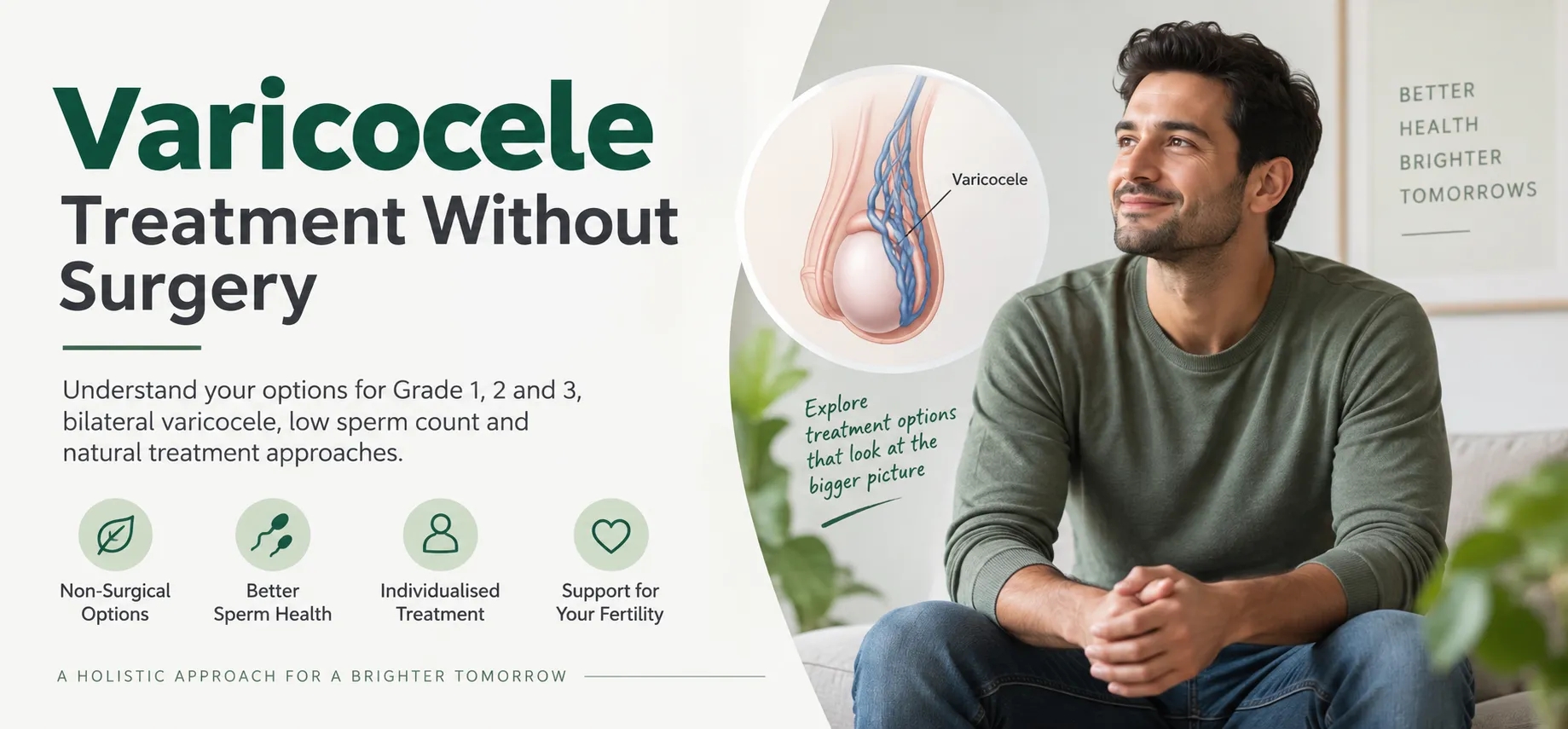
If you have been diagnosed with a varicocele, one of the first questions you may ask is:
“Do I really need surgery?”
The answer is, not always.
A varicocele does not automatically mean that you need an operation. Some men have a varicocele for years without significant pain, testicular problems or fertility issues. Others may have a varicocele associated with low sperm count, poor sperm motility, testicular shrinkage or difficulty conceiving.
So the important question is not simply, “Can varicocele be treated without surgery?”
It is:
“Is non-surgical treatment appropriate for my particular varicocele?”
At Welling Homeopathy, we see men who come to us after being advised to undergo varicocele surgery, particularly when they are also dealing with low sperm count, poor sperm motility or infertility.
Our approach is to first understand the complete picture rather than treating the ultrasound report alone.
This includes the grade of varicocele, whether it is unilateral or bilateral, semen analysis, testicular size, symptoms, age and fertility history.
What is a varicocele?
A varicocele is an enlargement of the veins around the testicle.
You can think of it as being somewhat similar to varicose veins in the legs. The veins around the testicle become enlarged because blood does not drain as efficiently as it should.
Varicoceles are most commonly found on the left side, although they can also occur on both sides.
Many men have no symptoms at all. Others may experience:
- A dragging or heavy feeling in the scrotum
- Dull aching pain
- Discomfort that becomes worse after standing for a long time
- Enlarged or prominent veins
- A difference in testicular size
- Low sperm count
- Reduced sperm motility
- Difficulty conceiving
Varicocele is relatively common. It is found in a significant proportion of men, including men undergoing evaluation for infertility.
But having a varicocele does not automatically mean that it is the reason for infertility.
That distinction is important.
Can varicocele be treated without surgery?
In some men, yes.
But there is an important difference between managing a varicocele without surgery and claiming that every varicocele can be permanently removed without surgery.
A varicocele is an anatomical problem involving enlarged veins. Medicines cannot simply make every enlarged vein disappear.
However, treatment does not always have to begin with surgery.
If a man has a varicocele but normal semen parameters, no significant pain and no evidence of testicular damage, observation may be appropriate.
If there are fertility problems, the situation needs a more detailed assessment.
Current urological guidelines generally consider varicocele repair in selected infertile men who have a palpable clinical varicocele and abnormal semen parameters. They do not recommend treating every varicocele automatically.
This is why a proper assessment matters before deciding on surgery.
Can Grade 1 varicocele be treated without surgery?
Grade 1 varicocele is generally detected when the veins become palpable during a Valsalva manoeuvre.
Many Grade 1 varicoceles do not require an operation.
If your semen analysis is normal, your testicular development is normal and you do not have significant symptoms, your doctor may recommend observation rather than immediate intervention.
If your semen parameters are abnormal, however, the varicocele should be considered as one possible contributing factor.
This is where looking only at the ultrasound report can be misleading.
A man with a small varicocele and very poor semen parameters may need more investigation than a man with a larger varicocele but completely normal fertility parameters.
What about Grade 2 varicocele?
Grade 2 varicocele can usually be felt without needing a Valsalva manoeuvre.
Again, the grade alone does not tell us whether surgery is necessary.
We need to look at:
Is there pain?
Is the testicle smaller than expected?
Is sperm production affected?
Are there repeated abnormal semen analyses?
Are you trying to have a child?
Are there other male or female fertility factors?
These questions are more useful than simply asking whether a Grade 2 varicocele should be operated on.
Can Grade 3 varicocele be treated without surgery?
This is one of the most common concerns I hear from patients.
Grade 3 is the most clinically obvious grade. The enlarged veins may be visible and palpable even without straining.
A Grade 3 varicocele deserves proper evaluation because higher-grade varicoceles can be associated with poorer semen parameters and testicular effects.
But Grade 3 does not automatically mean “surgery immediately.”
The decision should take into account the man’s fertility goals, semen analysis, testicular volume, symptoms and the overall clinical picture.
If you have been told:
“You have Grade 3 varicocele, so surgery is the only option.”
I would suggest taking a step back and asking another question.
What exactly are we trying to correct?
If the problem is infertility, we need to establish whether sperm production is actually affected and whether the varicocele is likely to be clinically relevant.
That assessment can help you make a more informed decision about whether to proceed directly to varicocele repair or explore conservative management first.
What if I have bilateral varicocele?
Bilateral varicocele means that enlarged veins are present on both sides.
This can understandably make men more worried about their fertility.
But bilateral varicocele does not automatically mean that surgery is unavoidable.
The same principles apply. We need to look at:
- Semen count
- Sperm motility
- Sperm morphology
- Testicular volume
- Testosterone and other relevant hormones when indicated
- Symptoms
- Duration of infertility
- Previous fertility treatments
- Female partner’s fertility factors
A bilateral varicocele can have a greater potential impact on sperm production because both testes may be exposed to the underlying physiological changes associated with varicocele. But the actual significance varies from person to person.
Can varicocele cause low sperm count?
It can.
Varicocele is associated with impaired semen parameters in some men. The exact mechanism is complex, but factors such as increased scrotal temperature, altered blood flow, oxidative stress and other changes around the testicle have been proposed.
This is why I do not recommend looking at a varicocele separately from the semen analysis.
For example, if a man has:
Grade 2 varicocele + low sperm count + low motility
that is a different clinical situation from:
Grade 2 varicocele + normal semen analysis + no symptoms.
The ultrasound finding is the same category.
The patient is not.
Can varicocele cause azoospermia?
Azoospermia means that no sperm are found in the ejaculate.
Varicocele can sometimes be found in men with azoospermia, particularly in men with non-obstructive azoospermia.
However, azoospermia has many possible causes. These include hormonal problems, genetic factors, testicular disorders, obstruction and problems with sperm production.
Therefore, azoospermia should never be attributed to varicocele without a proper male fertility evaluation.
Current evidence suggests that treating a clinical varicocele may allow sperm to reappear in the ejaculate in some men with non-obstructive azoospermia, but the quality of evidence is limited and this requires specialist assessment.
What is the natural treatment for varicocele?
This is where there is considerable confusion online.
You will find claims about exercises, supplements, herbs, medicines and various natural remedies that supposedly “cure” varicocele.
I would be careful with such claims.
There is no good reason to tell every patient that a supplement or exercise will physically eliminate an enlarged vein.
However, conservative treatment can have a role in selected patients.
The purpose may be to:
- Reduce discomfort
- Address factors that may affect sperm health
- Improve general reproductive health
- Monitor semen parameters
- Monitor testicular health
- Identify whether fertility improves without surgery
The exact approach needs to be individualised.
At Welling Homeopathy, this is how we approach patients who want to explore treatment without immediately proceeding to surgery.
We don’t start by saying that surgery is always necessary.
We also don’t start by promising that surgery will never be necessary.
We first assess the patient.
What can be done for varicocele without surgery?
A non-surgical approach may include several components depending on the individual case.
1. Treating the patient, not just the scan
An ultrasound can tell us that a varicocele is present.
It cannot, by itself, tell us how much that varicocele is affecting your fertility.
That is why semen analysis and clinical examination are important.
If the first semen analysis is abnormal, repeating the test can also be useful because semen parameters naturally fluctuate. The EAU guideline recommends at least two consecutive semen analyses when the baseline result is abnormal.
2. Looking at sperm health
If fertility is the reason you are seeking treatment, we need to know what is happening with the sperm.
This may include:
- Sperm concentration
- Total sperm count
- Progressive motility
- Morphology
- Semen volume
- Other investigations when clinically indicated
In selected cases, sperm DNA fragmentation testing may also be considered, particularly in situations such as recurrent pregnancy loss, failed assisted reproduction or unexplained infertility.
3. Addressing lifestyle factors
Lifestyle does not remove a varicocele.
But lifestyle factors can influence sperm health.
Depending on your situation, we may look at:
- Smoking
- Alcohol intake
- Excess body weight
- Sleep
- Heat exposure
- Exercise
- Diet
- Stress
- Certain medications
- Testosterone or anabolic steroid use
These factors are particularly important when the primary concern is fertility.
4. Monitoring rather than rushing into a procedure
Sometimes the most sensible approach is to monitor.
This can involve repeating semen analysis, assessing symptoms and following testicular size where appropriate.
If things remain stable, there may be no reason to rush into an intervention.
If there is deterioration, that changes the discussion.
Does homeopathy treat varicocele without surgery?
At Welling Homeopathy, we use an individualised homeopathic approach for men who want to explore non-surgical management of varicocele.
The treatment is based on the individual case rather than prescribing one medicine for everyone with a varicocele.
However, I want to make an important distinction.
Homeopathy should not be presented as a guaranteed way of making an anatomical varicocele disappear.
The more meaningful question for a man concerned about fertility is whether his symptoms, semen parameters and overall reproductive health can be monitored and supported without immediately proceeding to surgery.
If surgery becomes medically indicated, that possibility should not be ignored.
Your fertility matters more than avoiding a procedure at all costs.
Can varicocele improve sperm count without surgery?
This depends on the individual case.
If the varicocele is contributing to impaired sperm production, addressing other reversible factors may help sperm health.
But there is no reliable rule that says:
“Treat the varicocele naturally and sperm count will definitely increase.”
Sperm production is affected by many factors.
This is why I prefer to look at the semen analysis before and after treatment rather than making promises based only on symptoms.
A meaningful assessment should be measurable.
How long does it take to improve sperm count?
Sperm production is not an overnight process.
It takes time for changes in the sperm-producing cycle to become visible in a semen analysis.
The EAU guideline notes that improvement in semen parameters after varicocele repair is generally seen over up to two spermatogenic cycles.
This is also why I would be cautious about anyone promising a dramatic improvement in sperm count within a few days or weeks.
When treating male infertility, we need to think in terms of months rather than days.
When should you consider varicocele surgery?
There are situations where surgery or another varicocele intervention may be appropriate.
For example, current guidelines consider varicocele repair for selected men who are trying to conceive and have a palpable clinical varicocele, infertility and abnormal semen parameters.
Other factors can influence the decision.
These may include:
- Significant persistent pain
- Testicular growth or size concerns
- Abnormal semen parameters
- Fertility goals
- Recurrent or persistent varicocele
- Other findings on examination or investigation
The decision should be made after discussing the potential benefits, limitations and risks.
Does every varicocele need treatment?
No.
This is one of the most important things to understand.
A varicocele can exist without causing a clinically important problem.
The EAU specifically recommends against treating infertile men who have a subclinical varicocele and normal semen analysis, and recommends treatment decisions based on clinical findings and fertility factors rather than simply the presence of a varicocele.
So if you have recently been diagnosed with varicocele, don’t panic.
A diagnosis is the beginning of the assessment, not necessarily the end of the discussion.
What tests should I have for varicocele and infertility?
The exact tests depend on your history.
A fertility assessment may include:
Scrotal Doppler ultrasound
This helps assess the veins, reflux and testicular size. Physical examination remains important because varicocele is fundamentally a clinical diagnosis.
Semen analysis
This tells us whether sperm production and semen parameters are affected.
Hormonal evaluation
Depending on the semen analysis and clinical findings, testosterone, FSH, LH and other hormones may be considered.
Medical and fertility history
Previous pregnancies, duration of trying to conceive, medications, infections, surgeries and lifestyle factors can all be relevant.
In some men, additional investigations may be required.
Can I have children with a varicocele?
Yes, many men with varicocele can father children.
A varicocele does not automatically mean infertility.
The important question is whether it is affecting your reproductive function.
Some men with varicocele have completely normal sperm parameters and conceive naturally.
Others have reduced sperm production or other fertility problems.
That is why I would not advise judging your fertility based only on the size or grade of the varicocele.
Get the sperm tested.
Look at the complete picture.
Then decide what needs to be done.
Varicocele treatment without surgery at Welling Homeopathy
At Welling Homeopathy, we commonly see men who have been told that they need varicocele surgery, particularly men who are also dealing with:
- Low sperm count
- Low sperm motility
- Abnormal sperm morphology
- Azoospermia
- Difficulty conceiving
- Previous failed fertility treatment
- Bilateral varicocele
- Grade 2 or Grade 3 varicocele
Our approach is to understand the complete case before deciding on a treatment strategy.
We look at the varicocele report, semen analysis, fertility history, symptoms and other relevant factors.
If non-surgical management is reasonable in your situation, we can discuss that approach.
If there are findings that require surgical or specialist urological assessment, we will tell you that as well.
The aim is not to avoid surgery at any cost. The aim is to help you make the right decision for your fertility and health.
Frequently Asked Questions
Can Grade 3 varicocele be treated without surgery?
A Grade 3 varicocele can sometimes be managed conservatively, depending on symptoms, semen parameters, testicular health and fertility goals. However, Grade 3 varicocele should be properly evaluated because higher-grade varicoceles can be associated with abnormal semen parameters.
Can bilateral varicocele be treated without surgery?
Bilateral varicocele does not automatically mean surgery is necessary. The decision depends on whether the varicocele is clinically significant and whether there are problems such as abnormal semen parameters, pain or testicular changes.
Can varicocele be cured naturally?
Be careful with the word “cured.” A varicocele is an anatomical enlargement of veins. Conservative treatment may help manage symptoms and address associated fertility factors in selected patients, but there is no reliable evidence that natural remedies can physically eliminate every varicocele.
Can homeopathy help with varicocele?
Homeopathy can be considered as part of an individualised, non-surgical management approach at Welling Homeopathy. However, we do not promise that homeopathy will anatomically eliminate every varicocele. We assess the patient, monitor relevant parameters and determine whether non-surgical management is appropriate.
Can varicocele cause infertility?
Varicocele can be associated with impaired sperm production and male subfertility. However, not every man with a varicocele is infertile. A semen analysis and complete fertility evaluation are important.
Can varicocele cause low sperm count?
Yes. Varicocele is associated with abnormal semen parameters in some men. The relationship varies between individuals, so the semen analysis is important when assessing its significance.
Can varicocele cause azoospermia?
Azoospermia has many causes. Varicocele may be present in some men with non-obstructive azoospermia, but it should not automatically be assumed to be the cause. These patients need a proper male infertility evaluation.
Is surgery the only treatment for varicocele?
No. Some men require no treatment at all, while others may be candidates for conservative management. When a clinical varicocele is associated with infertility and abnormal semen parameters, urological guidelines may recommend considering varicocele repair.
Should I treat my varicocele if my sperm count is normal?
Not necessarily. A varicocele with normal semen parameters and no significant symptoms may simply require observation. Treatment decisions should be individualised.
My advice if you have been diagnosed with varicocele
Don’t make the decision based on the ultrasound report alone.
And don’t make it based on fear.
If you have been told that you have a Grade 1, Grade 2 or Grade 3 varicocele, or a bilateral varicocele, look at the whole picture.
Ask:
Is my sperm count normal?
Is my sperm motility normal?
Are my testicles developing normally?
Am I experiencing pain?
How long have we been trying to conceive?
Are there other factors affecting fertility?
Once we have these answers, the treatment decision becomes much clearer.
At Welling Homeopathy, we can assess your case and discuss whether a non-surgical approach is appropriate for you.
If you are looking for varicocele treatment without surgery, meet our experts at Welling Homeopathy.
Call +91 80 80 850 950 to discuss your case.