
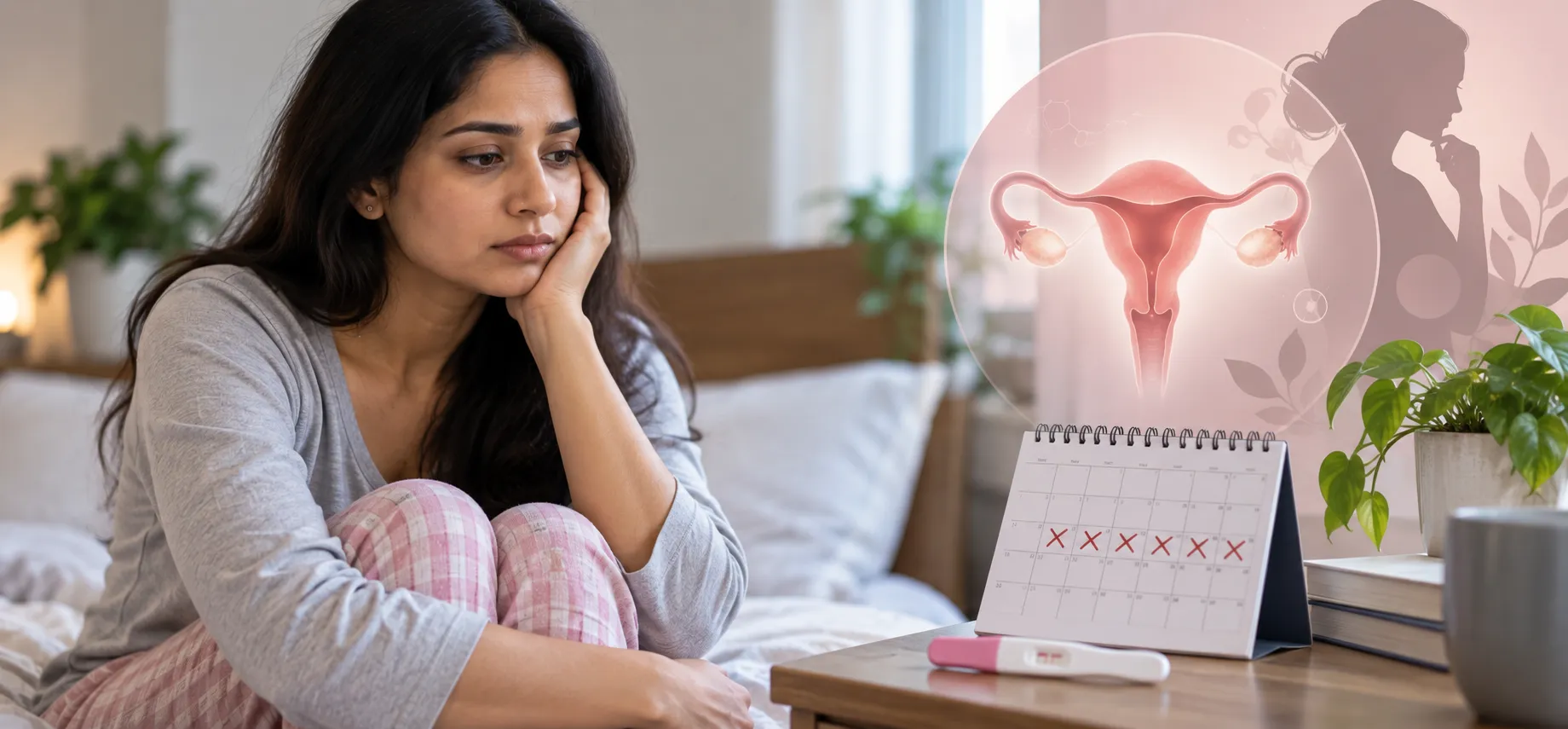
Amenorrhea means the absence of menstrual periods. It is not a disease by itself. It is a symptom that can have many different causes. For some women, missing a period may simply mean pregnancy. For others, it can be related to PCOS, thyroid problems, changes in weight, excessive exercise, stress, high prolactin levels, problems with ovarian function, certain medicines or other hormonal and reproductive conditions. If your periods have suddenly stopped, or you have been missing periods repeatedly, the important question is not simply “How can I get my period back?” It is “Why have my periods stopped?” Understanding the cause is the first step towards deciding what needs to be done. Amenorrhea is generally divided into primary amenorrhea, when menstruation has not started by the expected age, and secondary amenorrhea, when periods that had previously occurred stop for a prolonged period. Current reproductive medicine guidance recommends investigating secondary amenorrhea when periods have been absent for more than three months in someone who previously had regular cycles, or six months in someone whose cycles were already irregular.
Welling Homeopathy For Amenorrhea
At Welling Homeopathy, we understand that a missed period can mean very different things for different women. A teenager who has not started menstruating, a woman with PCOS whose periods have gradually become irregular, a woman who has suddenly stopped menstruating after losing weight, and a woman trying to conceive after her periods have stopped are not the same case.
With more than 24 years of experience in managing patients from 108 countries, our experts take an individualised approach to every patient. We look at the pattern of periods, age, symptoms, hormonal and medical history, lifestyle, previous investigations and past treatments before deciding how to approach the case. We also believe that the prognosis depends on the individual situation. The cause of amenorrhea, how long the periods have been absent, associated symptoms, age, ovarian function, previous treatment and overall health can all influence what happens next. Homeopathy should not be used to delay pregnancy testing, investigation of a significant hormonal problem or necessary specialist care.
Talk to our experts who would understand your individual case and provide an appropriate, personalised approach.
How Common Are Missed Periods?
Menstrual cycles naturally vary, particularly during adolescence, after childbirth, during breastfeeding and as menopause approaches. A period being a few days late does not automatically mean that something is wrong. However, persistent absence of periods deserves attention. Amenorrhea that is not explained by pregnancy, breastfeeding or menopause can have several medical causes, and a structured evaluation can usually narrow down the possibilities.
Primary and Secondary Amenorrhea
What Is Primary Amenorrhea?
Primary amenorrhea refers to a situation where menstruation has not started by the expected age. Current guidance recommends evaluation when a young woman has not had her first period by age 15 despite normal development of secondary sexual characteristics, or when breast development has not started by age 13.
Primary amenorrhea can have many causes. These include constitutional delay, problems involving the hypothalamus or pituitary gland, ovarian disorders, genetic conditions and anatomical differences affecting the uterus or reproductive tract. A young person who has not started menstruating should therefore be evaluated as an individual rather than being told simply to wait.
What Is Secondary Amenorrhea?
Secondary amenorrhea occurs when someone who has previously menstruated stops having periods. In someone with previously regular cycles, an absence of menstruation for more than three months generally warrants evaluation. If cycles were already irregular, six months without menstruation is a commonly used threshold for investigation.
Secondary amenorrhea is the type most people mean when they search online for “why have my periods stopped?” or “why am I not getting my periods?”
Why Have My Periods Stopped?
There is no single cause of missed periods. Menstruation depends on communication between the brain, pituitary gland, ovaries and reproductive tract. A problem at any point in this system can affect the menstrual cycle. Pregnancy, PCOS, thyroid disorders, high prolactin, reduced ovarian function, significant weight changes, excessive exercise, psychological stress, certain medications and structural problems are among the possibilities.
Common Causes of Amenorrhea
Pregnancy
Pregnancy should be the first possibility to consider when a sexually active woman with previously established periods misses a period. Even if pregnancy seems unlikely, testing is usually the simplest first step. In some situations, a blood pregnancy test may be appropriate because urine tests can occasionally be falsely negative.
Polycystic Ovary Syndrome
PCOS is one of the common reasons for irregular or absent periods. Some women with PCOS ovulate infrequently or do not ovulate regularly, which can lead to long gaps between periods. PCOS may also be associated with acne, increased facial or body hair, scalp hair thinning, weight changes and difficulty conceiving. However, not every woman with irregular periods has PCOS. A proper evaluation is important.
Thyroid Disorders
Both an underactive thyroid and an overactive thyroid can affect menstrual function. Thyroid problems may sometimes cause irregular periods, heavy periods or absent periods. This is why thyroid-stimulating hormone, or TSH, is commonly included in the evaluation of amenorrhea.
High Prolactin
Prolactin is a hormone produced by the pituitary gland. When prolactin levels are persistently elevated, menstrual periods can become irregular or stop. Some women also produce breast milk when they are not pregnant or breastfeeding, but the absence of breast discharge does not rule out high prolactin.
Sudden Weight Loss
A significant reduction in calorie intake or body weight can interfere with the hormonal signals required for ovulation. This can happen with restrictive dieting, eating disorders or other causes of inadequate energy availability.
Being Underweight
Very low body weight can affect reproductive hormone production. The body may reduce reproductive function when it does not have enough energy available to support normal physiological processes.
Excessive Exercise
High levels of endurance training or intense exercise combined with inadequate nutrition can suppress the reproductive hormone system and lead to functional hypothalamic amenorrhea.
Weight Gain and Metabolic Changes
Weight gain can be associated with hormonal and metabolic changes that affect ovulation. In some women, this occurs alongside PCOS or insulin resistance.
Psychological Stress
Significant psychological stress can affect the hypothalamic-pituitary-ovarian system and contribute to missed periods. However, it is important not to tell every woman with amenorrhea that “stress is the cause.” Stress is only one possible factor and should be considered alongside the rest of the history.
Perimenopause
As women approach menopause, ovulation becomes less predictable. Periods may become irregular and eventually stop. The age at which this happens varies between individuals.
Primary Ovarian Insufficiency
Primary ovarian insufficiency, sometimes called premature ovarian insufficiency, occurs when the ovaries stop functioning normally before the usual age of menopause. It can lead to missed periods, infertility and symptoms related to low estrogen. It requires medical evaluation because long-term low estrogen can have important health consequences.
Medications
Certain medicines can affect menstrual cycles. Some hormonal contraceptives can alter or suppress bleeding, while other medicines may influence the reproductive hormone system indirectly. A medication history is therefore an important part of the evaluation.
Uterine or Cervical Problems
Less commonly, structural problems can interfere with menstrual flow. Scar tissue inside the uterus, for example after certain procedures, can cause periods to become very light or stop altogether. Other anatomical conditions can cause primary amenorrhea.
Pituitary or Hypothalamic Disorders
The hypothalamus and pituitary gland coordinate many of the hormones involved in ovulation and menstruation. Problems affecting these areas can therefore result in amenorrhea. Persistent elevation of prolactin may also be associated with a pituitary lesion, which is why persistently abnormal prolactin levels sometimes require further investigation.
Symptoms of Amenorrhea
The most obvious symptom is the absence of menstrual bleeding. But the symptoms accompanying missed periods can provide important clues about the underlying cause.
Symptoms That May Occur With Amenorrhea
You may experience:
- Missed periods
- Irregular menstrual cycles
- Very infrequent periods
- Difficulty becoming pregnant
- Acne
- Increased facial or body hair
- Scalp hair thinning
- Weight gain or weight loss
- Hot flashes
- Vaginal dryness
- Breast discharge unrelated to breastfeeding
- Headaches
- Vision changes
- Reduced libido
- Excessive tiredness
- Changes in mood
The combination of symptoms is often more useful than the missed period alone.
Missed Periods and Pregnancy
If pregnancy is possible, take a pregnancy test before assuming that your missed period is due to hormones, PCOS or stress. This sounds obvious, but it is an important first step in the evaluation of secondary amenorrhea.
If a home pregnancy test is negative but your period remains absent and pregnancy is still possible, your doctor may recommend repeating the test or checking blood hCG depending on the circumstances.
Can Stress Cause Missed Periods?
Yes, significant stress can contribute to missed periods, but the situation is more complicated than saying “stress causes amenorrhea.”
The reproductive system responds to changes in energy availability, psychological stress, exercise and other physiological signals. Significant stress can disrupt the hormonal signals that control ovulation.
However, if your periods have stopped for several months, do not assume stress is the explanation without an evaluation. PCOS, thyroid disease, elevated prolactin, pregnancy and other causes need to be considered.
Can Weight Loss Cause Amenorrhea?
Yes. Significant or rapid weight loss can disrupt the hormonal signals required for normal ovulation. This is especially relevant when weight loss is accompanied by restrictive eating or intense exercise.
This type of amenorrhea is often referred to as functional hypothalamic amenorrhea. Treatment focuses on correcting the underlying energy imbalance and addressing contributing factors rather than simply forcing a period to occur.
Can Excessive Exercise Stop Periods?
Intense exercise can contribute to amenorrhea, particularly when the amount of energy being used is greater than the amount available from food.
This is more commonly seen in endurance athletes, dancers and people involved in very demanding training. The important issue is not exercise itself. Regular physical activity is generally beneficial. The problem is an imbalance between energy intake, energy expenditure and the body’s ability to maintain normal reproductive function.
Amenorrhea and PCOS
PCOS is an important cause of irregular periods and missed periods.
A woman with PCOS may ovulate only occasionally. As a result, periods may occur every few months rather than monthly.
Other Signs of PCOS
PCOS may also be associated with:
- Acne
- Excess facial or body hair
- Hair thinning on the scalp
- Weight gain or difficulty losing weight
- Insulin resistance
- Difficulty conceiving
But PCOS is not diagnosed simply because periods are irregular. A proper evaluation is needed, and other causes of irregular or absent periods may need to be excluded.
Amenorrhea and Thyroid Problems
The thyroid and reproductive systems are closely connected. Both hypothyroidism and hyperthyroidism can interfere with normal menstrual function.
If you have missed periods together with symptoms such as unusual tiredness, sensitivity to cold or heat, changes in weight, palpitations, constipation, diarrhoea or changes in hair and skin, thyroid testing may be appropriate.
A TSH test is commonly part of the initial evaluation of amenorrhea.
Amenorrhea and High Prolactin
High prolactin can interfere with the hormones responsible for ovulation and menstruation.
Symptoms of High Prolactin
Some women may have:
- Missed periods
- Irregular periods
- Difficulty conceiving
- Breast milk discharge
- Headaches
- Vision problems
However, not everyone with elevated prolactin develops breast discharge.
Persistently elevated prolactin needs appropriate medical evaluation because it can sometimes be associated with a pituitary disorder.
How Is Amenorrhea Diagnosed?
Amenorrhea is not diagnosed simply by looking at the menstrual calendar. The aim of evaluation is to identify why menstruation has stopped.
Medical History
Your doctor may ask:
- When was your last period?
- Were your periods previously regular?
- At what age did your periods begin?
- Could you be pregnant?
- Have you recently lost or gained weight?
- Has your exercise routine changed?
- Have you experienced significant stress?
- Are you trying to conceive?
- Do you have acne or increased facial hair?
- Have you noticed breast discharge?
- Are you experiencing hot flashes?
- Have you had headaches or vision changes?
- Have you had previous pelvic surgery or procedures?
- What medicines or hormonal contraception are you taking?
Pregnancy Testing
Pregnancy should generally be excluded first in someone with secondary amenorrhea.
Thyroid Testing
TSH is commonly checked because thyroid disorders can affect menstruation even when obvious thyroid symptoms are absent.
Prolactin Testing
Prolactin is commonly measured because elevated prolactin can suppress reproductive hormone function and cause amenorrhea.
FSH and Estradiol
FSH and estradiol can help distinguish between different patterns of ovarian and hypothalamic-pituitary dysfunction. Elevated FSH with low estradiol can point towards ovarian insufficiency, while low or normal FSH in the appropriate clinical setting can suggest a hypothalamic or pituitary cause. Results need to be interpreted alongside the clinical history.
Androgen Testing
If missed periods occur together with acne, excess facial hair or other signs of androgen excess, testosterone and other androgen-related tests may be considered.
Pelvic Ultrasound
A pelvic ultrasound can provide information about the uterus, endometrium and ovaries. It can be useful when PCOS, ovarian abnormalities, structural problems or other pelvic causes are being considered.
Other Tests
Additional investigations depend on the individual case. Some women may require pituitary imaging, genetic testing, assessment for congenital conditions or evaluation for uterine scarring.
The important point is that not every woman with a missed period needs every possible test. Investigations should be guided by the history and examination.
What Happens If You Ignore Missed Periods?
A single late period is usually not a reason to panic. Persistent amenorrhea is different.
If periods stop because estrogen levels are very low, prolonged untreated hypoestrogenism can have consequences for bone health. The underlying condition may also need treatment.
Amenorrhea caused by PCOS can be associated with prolonged periods without ovulation and may require attention to the endometrium depending on the individual situation.
If the cause is primary ovarian insufficiency, thyroid disease, hyperprolactinemia or another endocrine disorder, identifying the condition matters for long-term health as well as menstruation.
So the goal should not simply be to make bleeding occur. The goal is to understand why it stopped.
Amenorrhea Treatment
There is no single treatment for amenorrhea because amenorrhea itself is a symptom rather than one disease.
Treatment depends on the underlying cause.
Treatment for PCOS-Related Amenorrhea
Management may include lifestyle measures, treatment of metabolic risk factors, hormonal treatment to regulate bleeding, or fertility treatment when pregnancy is desired.
The right approach depends on the woman’s symptoms and reproductive goals.
Treatment for Thyroid-Related Amenorrhea
If a thyroid disorder is responsible, treating the thyroid condition may allow menstrual cycles to improve.
Treatment for High Prolactin
Persistent hyperprolactinemia needs evaluation. Depending on the cause, treatment may involve medicines that lower prolactin or treatment of an underlying pituitary condition.
Treatment for Functional Hypothalamic Amenorrhea
When amenorrhea is related to inadequate energy availability, excessive exercise, weight loss or significant psychological stress, treatment focuses on restoring adequate nutrition and energy availability, modifying excessive exercise and addressing psychological factors where appropriate.
Simply prescribing hormones without addressing the underlying energy imbalance may not solve the fundamental problem.
Treatment for Primary Ovarian Insufficiency
Primary ovarian insufficiency requires medical management because reduced estrogen exposure can affect bone and cardiovascular health as well as fertility. Hormone therapy may be recommended in appropriate patients until the usual age of menopause unless there is a reason not to use it.
Treatment for Anatomical Causes
Some structural causes of amenorrhea may require surgical treatment.
The treatment depends entirely on the anatomical problem.
Homeopathy Treatment for Amenorrhea
We specialize in fertility treatment and women’s health. And amenorrhea is one of the most common ones in both of them.
At Welling Homeopathy, we understand why. Women prefer to explore a personalised approach before starting long-term medication, while others may already have undergone several treatments and are looking for additional support.
But amenorrhea needs to be approached carefully.
There is exhaustive good-quality clinical evidence to say that homeopathy can reliably restore menstruation regardless of the underlying cause, and Welling Homeopathy must be a replacement for conventional hormonal medicines. Sometimes we need to start with investigating pregnancy, PCOS, thyroid disease, hyperprolactinemia, primary ovarian insufficiency or structural problems.
Our approach is therefore not to give every woman with a missed period the same medicine.
How We Approach Amenorrhea
We take a detailed history of:
- The age at which periods started
- Previous menstrual pattern
- Date of the last period
- Duration of the problem
- Pregnancy history
- Fertility concerns
- PCOS symptoms
- Weight changes
- Exercise patterns
- Sleep
- Stress and emotional health
- Thyroid history
- Previous hormonal tests
- Prolactin levels where available
- Previous ultrasound findings
- Previous treatments
- Current medicines
The aim is to understand the individual rather than simply treat the label “amenorrhea.”
Individualised Treatment
Two women can have the same diagnosis of amenorrhea for completely different reasons.
One may have PCOS. Another may have hypothalamic amenorrhea after significant weight loss. Another may have thyroid dysfunction. Another may have reduced ovarian function.
This is why our experts do not believe in a one-size-fits-all approach.
Prognosis Depends on the Cause
The prognosis for amenorrhea is also individual.
If periods have stopped because of a temporary hormonal disturbance, cycles may return after the underlying problem is corrected.
If amenorrhea is related to PCOS, menstrual function may improve with appropriate management, although the tendency towards irregular ovulation can persist.
If the cause is primary ovarian insufficiency or a structural problem, the situation is different.
This is why we prefer to discuss prognosis after understanding the individual’s stage, symptoms, investigations and previous treatments.
Can Homeopathy Help With Missed Periods?
If you are considering homeopathy for missed periods, it is important to first understand the cause of your amenorrhea.
Homeopathy should not be used to delay pregnancy testing or medical evaluation.
At Welling Homeopathy, our experts review the complete case and the available medical reports before deciding whether an individualised homeopathic approach is appropriate.
If we identify features that require investigation or specialist care, we advise patients accordingly.
Our aim is not simply to make a period appear. It is to understand the health issue associated with the missing periods and support the individual appropriately.
Amenorrhea and Fertility
One of the biggest concerns women have after their periods stop is:
“Can I still get pregnant if I am not getting my periods?”
It depends on why the periods have stopped.
If ovulation is not occurring, natural conception becomes difficult because an egg may not be released regularly.
But amenorrhea does not always mean that pregnancy is impossible.
For example, some women with PCOS may ovulate intermittently even when their cycles are very irregular.
Other causes, such as primary ovarian insufficiency, can have a very different effect on fertility.
If you are trying to conceive and have stopped getting periods, do not simply wait for menstruation to return. A fertility-focused evaluation can help identify what is happening with ovulation and reproductive hormones.
Can You Ovulate Without a Period?
It is possible to ovulate before the first period after a period of amenorrhea.
This is particularly relevant when someone is trying to avoid pregnancy. A person who has not had a period for several months should not automatically assume that pregnancy is impossible.
For women trying to conceive, identifying whether ovulation is occurring can be an important part of the evaluation.
Amenorrhea After Stopping Birth Control
Hormonal contraception can change menstrual bleeding patterns.
Some contraceptives suppress ovulation and can make periods very light or absent while they are being used.
After stopping hormonal contraception, menstrual cycles may take some time to settle. However, persistent absence of periods should not automatically be attributed to the previous contraceptive. Pregnancy and other causes should still be considered when appropriate.
Amenorrhea After Pregnancy and Breastfeeding
Periods may remain absent during breastfeeding because prolactin and changes in the reproductive hormone system can suppress ovulation.
The timing of the return of periods varies considerably between women.
However, breastfeeding does not guarantee that pregnancy cannot occur. Ovulation can return before the first postpartum period.
If you are not breastfeeding and periods remain absent after pregnancy, or if there are other concerning symptoms, medical evaluation may be appropriate.
Missed Periods in Teenagers
Irregular cycles are common during the first years after menstruation begins because the reproductive hormone system is still maturing.
But prolonged absence of periods should not simply be dismissed as “normal teenage irregularity.”
Primary amenorrhea requires evaluation when menstrual development has not occurred by the expected age, and delayed puberty may need earlier assessment when breast development has not started by age 13.
When Should You See a Doctor for Missed Periods?
You should consider medical evaluation if:
- Your periods have stopped for more than three months after previously regular cycles
- Your periods have been absent for six months when your cycles were previously irregular
- You have never started menstruating by the expected age
- You are trying to conceive and your periods have stopped
- You have symptoms of PCOS
- You have symptoms of thyroid disease
- You have breast discharge unrelated to breastfeeding
- You have severe headaches or changes in vision
- You have significant or unexplained weight loss
- You have symptoms of premature ovarian insufficiency
- You have severe pelvic pain
- You have other concerning symptoms
Persistent headaches, visual changes or other neurological symptoms together with menstrual changes deserve particular attention because some pituitary conditions can affect both hormone production and vision.
Can Missed Periods Be Prevented?
Not every cause of amenorrhea can be prevented. Genetic conditions, ovarian disorders and some anatomical problems are not something a person can prevent through lifestyle changes.
However, some contributors can be addressed.
Maintain adequate nutrition
Avoid extreme dieting and prolonged calorie restriction.
Exercise sensibly
Regular physical activity is beneficial, but excessive training combined with inadequate nutrition can interfere with reproductive function.
Maintain a healthy weight
Both very low weight and significant metabolic problems associated with excess weight can affect menstruation.
Manage chronic health conditions
Thyroid disease, diabetes, PCOS and other chronic conditions should be appropriately managed.
Pay attention to persistent menstrual changes
Your menstrual cycle is useful health information. A significant change that persists should not simply be ignored.
Frequently Asked Questions About Amenorrhea
What is amenorrhea?
Amenorrhea means the absence of menstrual periods. It can be primary, when menstruation has not started by the expected age, or secondary, when previously established periods stop.
What are the most common causes of missed periods?
Common causes include pregnancy, PCOS, thyroid disorders, high prolactin, significant weight changes, excessive exercise, functional hypothalamic amenorrhea, medications and changes in ovarian function.
Why am I not getting my periods but I am not pregnant?
There are many possible explanations, including PCOS, thyroid problems, high prolactin, weight changes, excessive exercise, stress-related hypothalamic suppression, ovarian insufficiency and other hormonal or structural conditions. An evaluation is needed to identify the cause.
How long can you go without a period before seeing a doctor?
If previously regular periods have been absent for more than three months, evaluation is generally recommended. If cycles were already irregular, six months without menstruation is commonly used as a threshold for investigation. Earlier evaluation may be appropriate depending on age, symptoms and fertility goals.
Can PCOS cause periods to stop completely?
Yes. Some women with PCOS may go for prolonged periods without menstruating because ovulation is infrequent or absent.
Can thyroid problems cause missed periods?
Yes. Both an underactive and overactive thyroid can affect menstrual function.
Can stress stop your periods?
Significant psychological stress can contribute to amenorrhea, particularly when combined with changes in eating, weight or exercise. However, persistent amenorrhea should not automatically be blamed on stress.
Can being underweight cause amenorrhea?
Yes. Low energy availability and significant weight loss can suppress the hormonal signals required for normal ovulation and menstruation.
Can excessive exercise cause missed periods?
Yes. Very intense exercise, particularly when combined with inadequate energy intake, can suppress reproductive hormone function.
Can you get pregnant if you have amenorrhea?
Pregnancy depends on whether and why ovulation is occurring. Amenorrhea often means ovulation is not occurring regularly, but ovulation can occasionally happen before a period returns. Women trying to conceive should have the underlying cause evaluated.
Can homeopathy cure amenorrhea?
There is currently insufficient high-quality evidence to say that homeopathy can reliably cure amenorrhea regardless of its cause. At Welling Homeopathy, we take an individualised approach and do not recommend using homeopathy as a substitute for necessary investigation or specialist treatment.
What tests are done for amenorrhea?
Depending on the individual case, evaluation may include a pregnancy test, TSH, prolactin, FSH, estradiol, androgen testing and pelvic ultrasound. Additional tests may be needed depending on the symptoms and initial results.
Does amenorrhea affect fertility?
It can. If periods are absent because ovulation is not occurring, conception can be difficult. The effect on fertility depends on the underlying cause.
What is the difference between amenorrhea and irregular periods?
Amenorrhea means periods are absent for a prolonged period. Irregular periods means menstrual cycles occur, but their timing or frequency is outside the expected pattern. A woman can move from irregular periods to amenorrhea, particularly when ovulation becomes less frequent.
Final Thoughts
A missed period is easy to dismiss, particularly if it happens once. But when periods repeatedly disappear or stop for several months, your body may be telling you that something has changed.
Sometimes the reason is relatively straightforward. Sometimes it is PCOS. Sometimes it is thyroid dysfunction. Sometimes it is a change in weight, exercise or energy availability. Sometimes high prolactin or ovarian function is involved. And sometimes a less common hormonal or structural condition needs to be investigated.
The most important thing is not to treat every missed period in the same way.
At Welling Homeopathy, our experts take time to understand the individual woman, her menstrual history, associated symptoms, reproductive goals, investigations and previous treatments. With more than 24 years of experience and patients managed from 108 countries, we understand that two women with the same diagnosis can have very different health situations.
We also believe that prognosis should be discussed individually. The cause of amenorrhea, duration of the problem, stage of the condition, associated symptoms, age and response to previous treatment can all influence the outlook.
If you have persistent missed periods and want to understand what may be behind them, you can speak with our experts at Welling Homeopathy.
Meet Our Experts
Bring your previous blood reports, hormone tests, ultrasound reports and details of previous treatment if you have them. Our experts can review your history and help you understand the next appropriate step.
Call Welling Homeopathy at +91 80 80 850 950 to speak with our experts.
