
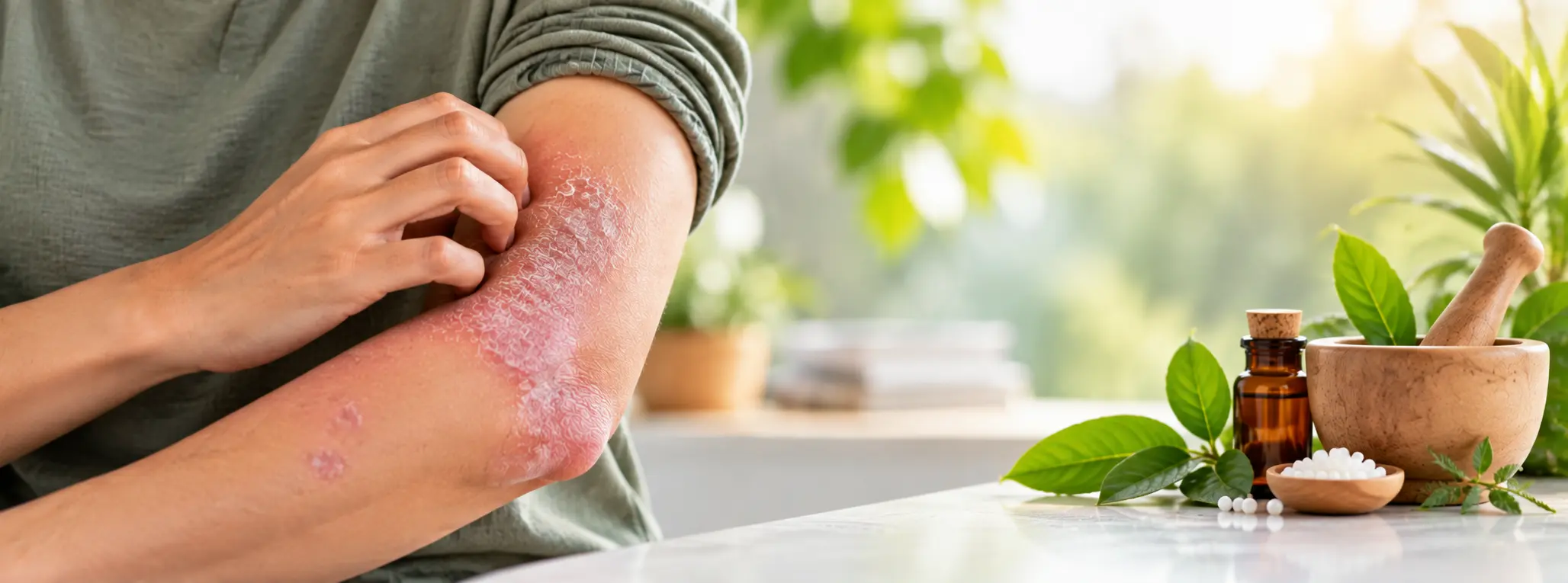
What Patients Should Know Before Starting Treatment for Psoriasis?
One of the most frustrating things about psoriasis is that it can improve for some time and then come back again. You may have clear skin for weeks or months, and then suddenly notice itching, redness and scaling returning. This is why many people with psoriasis eventually start asking a different question. Not just “How do I treat this patch?” but “Why does my psoriasis keep coming back?”
If you have been dealing with recurring psoriasis and want to understand whether a personalised homeopathic treatment may be suitable for you, you can speak to our experts at Welling Homeopathy. Call +91 80 80 850 950 to meet our experts.
What is psoriasis?
Psoriasis is a chronic inflammatory skin condition. It causes skin cells to build up faster than usual, resulting in areas of thickened, dry or scaly skin.
It can occur on different parts of the body. The elbows, knees, scalp and lower back are common areas, but psoriasis can also affect the hands, feet, nails and other parts of the body.
The appearance can be different from one person to another. Some people have small patches. Others have larger areas of affected skin.
And there is one thing that is important to understand from the beginning.
Psoriasis is not contagious.
You cannot get psoriasis by touching someone who has it.
Why does psoriasis keep coming back?
This is probably one of the most important questions for someone living with psoriasis.
A cream may make the skin look better. The itching may reduce. The scaling may disappear. But after some time, the same problem may return.
There is a reason for this.
Psoriasis is not simply a problem of dry skin. It involves the immune system and inflammation. Genetics can also have a role. Certain factors can trigger or worsen a flare-up in people who are susceptible to psoriasis.
These triggers can include stress, infections, injuries to the skin, smoking, alcohol and certain medicines. But triggers are not the same for everyone.
This is why I prefer not to look at psoriasis only as a skin patch.
I want to understand the pattern of the problem.
When did it start?
Where did it start?
What was happening around that time?
What makes it worse?
What makes it better?
Does it return in the same place?
How has it responded to treatment in the past?
These questions can tell us much more about an individual case.
Can homeopathy help psoriasis?
This is where I would like to be very clear.
There is no good scientific evidence that homeopathy can cure psoriasis, and it should not be promoted as a replacement for proven dermatological treatment.
At the same time, some patients look for a personalised homeopathic approach, particularly when they have been dealing with recurring symptoms for a long time.
At Welling Homeopathy, we do not believe that every person with psoriasis should be approached in exactly the same way.
Our experts take a detailed history and try to understand the individual pattern of the condition before discussing treatment.
That does not mean that homeopathy is suitable for everyone. It also does not mean that a patient should stop treatment prescribed by their dermatologist.
The first step should always be to understand the condition properly and make sensible treatment decisions.
Why two people with psoriasis may need different approaches
Imagine two people who both have psoriasis on their elbows.
On paper, their diagnosis is the same.
But their experience may be completely different.
One person may have intense itching at night. Another may have very thick scaling but little itching.
One may notice that the condition becomes worse during stressful periods. Another may not see any relationship with stress.
One may have had psoriasis for 15 years. Another may have developed it recently.
One may also have nail changes or joint stiffness.
So although the diagnosis is the same, the individual picture is not the same.
This is why a detailed consultation matters.
What do we look at during a psoriasis consultation?
When someone comes to us for psoriasis treatment, we want to understand more than just where the patches are.
We may ask about:
- When the psoriasis first appeared
- Where it started
- How it has changed over time
- The amount of itching
- The nature of the scaling
- Whether the scalp or nails are affected
- What seems to trigger flare-ups
- Previous treatments and how the skin responded
- Whether the condition returns after treatment is stopped
- Other symptoms that may be occurring at the same time
- How psoriasis is affecting sleep, work and everyday life
There is no single question that gives us the answer.
It is the overall pattern that becomes important.
Can stress make psoriasis worse?
Many patients tell me that their psoriasis becomes worse when they are going through a stressful period.
Stress is not necessarily the original cause of psoriasis. But for some people, it can be associated with flare-ups.
This is an important distinction.
I would not tell a patient that “your psoriasis is only because of stress.” That is too simplistic.
Psoriasis is a complex condition.
But if someone repeatedly notices that their skin worsens during periods of significant stress, that pattern is worth discussing during the consultation.
What about steroid creams for psoriasis?
Steroid creams and other topical medicines are commonly used to control psoriasis. They can be very useful when appropriately prescribed.
The important point is to use them correctly.
Some people become worried about using steroids. Others use them for long periods without regular medical supervision. Neither approach is ideal.
If you have been prescribed a steroid cream, do not suddenly stop it because you have read something online.
Talk to the doctor who prescribed it and understand how it should be used.
If you are considering homeopathy alongside your existing treatment, tell both doctors about the treatments you are taking.
Good healthcare should not involve hiding one treatment from another doctor.
What if psoriasis affects the scalp?
Scalp psoriasis can be particularly troublesome.
Patients may notice thick scaling, itching and visible flakes. Sometimes the psoriasis can extend beyond the hairline.
It can also be confused with dandruff or other scalp conditions.
If you have persistent scalp scaling that does not improve with ordinary dandruff treatment, it is worth getting the diagnosis checked.
The treatment approach will depend on what is actually causing the problem.
What if psoriasis affects the nails?
Psoriasis can also affect the fingernails and toenails.
You may notice:
- Small pits in the nails
- Thickening
- Changes in colour
- Separation of the nail from the nail bed
- Changes in the normal shape of the nail
Nail changes should not simply be assumed to be psoriasis. Fungal infections and other conditions can produce similar changes.
This is another reason why getting the diagnosis right matters.
Can psoriasis affect the joints?
Yes.
This is something I would particularly want a patient with psoriasis to be aware of.
Some people with psoriasis develop psoriatic arthritis. Symptoms can include joint pain, stiffness and swelling.
If you have psoriasis and are experiencing persistent joint pain or stiffness, especially in the morning, do not ignore it.
You should have the problem medically assessed.
Skin treatment alone may not be enough if the joints are involved.
Can psoriasis be cured permanently?
This is probably the question patients want answered most directly.
At present, psoriasis is generally considered a chronic condition. There is no universally accepted treatment that permanently eliminates psoriasis in every person.
However, that does not mean that nothing can be done.
There are several established treatments that can control psoriasis and improve quality of life. Depending on the severity and type of psoriasis, treatment may include topical medicines, phototherapy, systemic medicines or biologic treatments.
The right option depends on the individual patient.
I would therefore be cautious about anyone who promises a guaranteed permanent cure for psoriasis.
A responsible doctor should explain what is known, what is uncertain and what the realistic expectations are.
What can you do when psoriasis keeps flaring up?
Start by looking for patterns.
Keep a simple record of when your flare-ups happen.
Think about:
- Stress
- Recent infections
- Changes in medicines
- Skin injuries
- Smoking or alcohol
- Changes in your routine
- Sleep
- Other changes that happen around the same time
You may not find an obvious trigger. That is completely normal.
But keeping track can sometimes help you and your doctor understand the condition better.
Also, continue any prescribed treatment as advised. Do not make major changes to treatment based only on something you have read online.
When should you see a doctor about psoriasis?
If you have persistent patches of red, thickened or scaly skin, it is worth getting the diagnosis confirmed.
You should seek medical advice particularly if:
- Your psoriasis is spreading quickly
- Large areas of your body are affected
- Your skin is painful or bleeding
- You notice signs of infection
- Your nails are changing significantly
- You develop joint pain or stiffness
- Your symptoms are affecting sleep or daily activities
- Your current treatment is no longer controlling the condition
Some forms of psoriasis can be serious and require prompt medical attention.
How Welling Homeopathy approaches psoriasis
At Welling Homeopathy, we believe that a psoriasis consultation should not be reduced to looking at a photograph of the skin and choosing a medicine.
Our experts spend time understanding the history of the condition.
We want to know how it started, how it behaves, what changes it, what treatment has already been tried and how the person has responded.
The aim is to understand the individual rather than simply the name of the disease.
If homeopathic treatment is considered appropriate, the approach is personalised to that individual.
At the same time, we believe in responsible healthcare. We do not advise patients to ignore serious symptoms or abandon necessary medical treatment.
Start Healing Now
Living with psoriasis can be frustrating, particularly when you have periods of improvement followed by another flare-up.
There is no single solution that works for every person. Psoriasis is a chronic condition, and treatment needs to take into account its severity, location, symptoms and effect on your life.
If you have been struggling with recurring psoriasis and want to understand your condition better, a detailed consultation can be a useful first step.
At Welling Homeopathy, our experts take the time to understand your individual psoriasis pattern and discuss whether a personalised homeopathic approach is appropriate for you.
To speak with our experts at Welling Homeopathy, call +91 80 80 850 950 and book a consultation.