
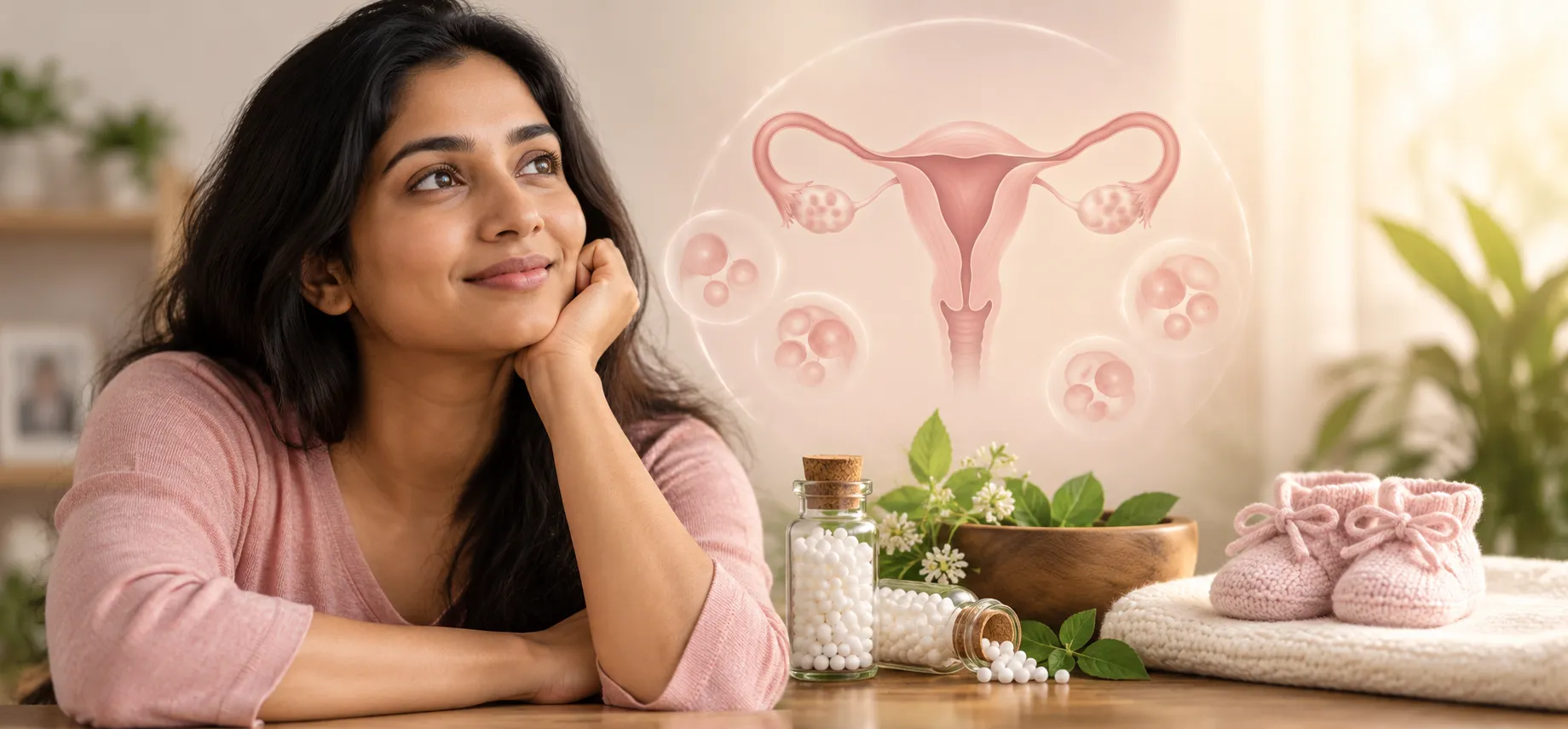
A Complete Guide for Women Trying to Conceive
If you have PCOS and are trying to get pregnant, you may have already heard many different things about your chances of conceiving. Some people may tell you that pregnancy will be very difficult. Others may tell you that you simply need to lose weight or regulate your periods.
The truth is a little more complicated.
PCOS can affect ovulation and make it harder to conceive, but having PCOS does not mean that you cannot become pregnant. Many women with PCOS do conceive, sometimes naturally and sometimes with help. The important thing is to understand what is actually causing the difficulty in getting pregnant in your particular case.
If you have PCOS and have been trying to conceive, you can speak to our experts at Welling Homeopathy to understand your individual situation and discuss a personalised approach. Call +91 80 80 850 950 to meet our experts.
What is the connection between PCOS and infertility?
One of the main reasons PCOS can affect fertility is irregular or absent ovulation.
In a normal menstrual cycle, an egg usually develops and is released from the ovary. This is called ovulation.
In PCOS, hormonal changes can interfere with this process. Some women may ovulate irregularly, while others may not ovulate regularly at all.
This means that even if you are having periods, you may not be ovulating consistently.
That is an important point.
Having a period does not always mean that ovulation has occurred.
PCOS is recognised as one of the common causes of female infertility.
But PCOS is not the same as permanent infertility.
That distinction is very important.
Can you get pregnant naturally with PCOS?
Yes.
A diagnosis of PCOS does not mean that you will definitely need IVF or other fertility treatment.
Some women with PCOS ovulate occasionally and become pregnant naturally. Others may need help to restore or induce regular ovulation.
The approach depends on several things, including your age, how often you ovulate, how long you have been trying, whether there are other fertility factors and whether your partner has any fertility issues.
So I would not look at the PCOS diagnosis alone and try to predict someone’s chances of pregnancy.
I would first want to understand the complete picture.
Why does PCOS make it difficult to get pregnant?
PCOS can affect fertility in several ways.
The most important is irregular ovulation.
But there can also be other factors associated with PCOS, including insulin resistance, changes in androgen levels, weight-related metabolic problems and other hormonal disturbances.
Not every woman with PCOS has all of these problems.
This is why two women with the same diagnosis can have very different symptoms and very different fertility journeys.
One woman may have irregular periods but otherwise feel well.
Another may have irregular periods, acne, increased facial hair and difficulty managing weight.
Someone else may have relatively few symptoms but may be ovulating very infrequently.
The diagnosis is the same.
The individual situation is not.
What are the signs that PCOS may be affecting fertility?
Some women already know they have PCOS because of symptoms such as irregular periods, acne or excess hair growth.
Others discover the condition only when they start trying for a baby.
Some signs that ovulation may not be regular include:
- Periods that come very late
- Skipping periods
- Very irregular menstrual cycles
- Long gaps between periods
- Difficulty predicting fertile days
- Difficulty becoming pregnant despite regular attempts
However, symptoms alone cannot tell us whether a woman is ovulating.
If you are trying to conceive and your periods are irregular, it is worth discussing this with a gynaecologist or fertility specialist.
Does PCOS always cause infertility?
No.
This is one of the biggest misconceptions about PCOS.
PCOS can make conception more difficult, particularly when ovulation is irregular, but it does not mean that pregnancy is impossible.
In fact, fertility treatment for PCOS can be very effective for many women.
Current international guidance recommends evidence-based treatment for women with PCOS who have anovulatory infertility. For women who are not ovulating and have no other infertility factors, letrozole is recommended as the first-line medication for ovulation induction.
This is something every woman with PCOS should know before assuming that she will need IVF.
Can homeopathy help PCOS and infertility?
This is where I would like to be careful.
Women searching for homeopathy for PCOS and infertility are often looking for a more personalised approach. They may have irregular periods, hormonal symptoms or difficulty conceiving and may prefer to explore homeopathy.
At Welling Homeopathy, our experts take an individualised approach to such cases.
We look at the menstrual history, symptoms, previous treatment, lifestyle, fertility history and other relevant factors before discussing whether homeopathic treatment is appropriate.
But I would not tell a woman that homeopathy can guarantee pregnancy or permanently cure PCOS.
There is not enough good-quality evidence to make that claim.
If you are trying to conceive, the most important thing is that your fertility is properly assessed and that you do not delay treatments that may be important for you.
Homeopathy, if chosen, should not be used as a reason to avoid appropriate fertility care.
What do we look at when a woman with PCOS comes to us?
The first consultation is not simply about asking whether you have PCOS.
I want to know how your menstrual cycle behaves.
For example:
How many days usually pass between your periods?
Do you sometimes go two or three months without a period?
When did the irregularity begin?
Were your periods always irregular or did this change later?
Have you previously taken hormonal medicines or fertility medicines?
Have you tried to conceive before?
Have you had a pregnancy previously?
What investigations have already been done?
These details matter.
We also need to know whether there could be another reason for difficulty conceiving.
That is because not every fertility problem in a woman with PCOS is caused by PCOS.
PCOS is not the only thing we should investigate
This is an important point that is sometimes missed.
If a woman has PCOS and is not becoming pregnant, it is tempting to assume that PCOS is the entire explanation.
It may not be.
Age matters.
Ovulation matters.
The fallopian tubes matter.
The uterus matters.
And the male partner’s fertility matters too.
A proper infertility evaluation may therefore include assessment of both partners rather than focusing only on the woman.
This is particularly important when a couple has been trying to conceive for some time.
What about weight and PCOS?
Weight is often discussed when PCOS and fertility are mentioned.
For women who are overweight, even modest weight loss may improve some PCOS-related outcomes and may help make menstrual cycles more regular in some cases. Lifestyle management is an important part of PCOS care.
But I would avoid making this into a simple message of:
“Lose weight and you will get pregnant.”
It is not that simple.
Women with PCOS can have very different body types and metabolic profiles. Some women with PCOS are not overweight at all.
So weight should be considered as one part of the overall picture, not as the explanation for every fertility problem.
Can irregular periods be treated?
Sometimes.
The answer depends on why the periods are irregular and whether pregnancy is the goal.
When a woman is trying to conceive, the priority is different from when she is trying to control PCOS symptoms but does not want pregnancy.
If pregnancy is the goal, the doctor needs to know whether ovulation is occurring and how frequently.
This is why simply making the periods appear regular is not always the same as improving fertility.
The real question is not only, “Are my periods regular?”
It is also:
“Am I ovulating?”
That distinction can change the entire approach.
What fertility treatment is available for women with PCOS?
There are several options.
The appropriate treatment depends on the individual woman and whether there are other fertility factors.
For women with PCOS who are not ovulating and have no other infertility factors, current international guidelines recommend letrozole as the first-line pharmacological treatment for ovulation induction. Other options, including metformin, clomiphene and assisted reproductive treatments, may have a role in selected situations.
Some women may eventually need IUI or IVF, particularly when there are additional fertility problems or when earlier treatment has not worked.
But having PCOS does not automatically mean IVF.
This is worth repeating because I meet many women who become frightened as soon as they hear the word PCOS.
Can PCOS be cured?
There is no single permanent cure for PCOS.
PCOS is a long-term condition that can be managed in different ways depending on the symptoms and the woman’s goals.
If pregnancy is the immediate goal, fertility becomes an important part of the treatment plan.
If pregnancy is not currently the goal, the focus may be different and could include managing periods, acne, excess hair, metabolic health and other symptoms.
So I would not ask only:
“How do we cure PCOS?”
I would ask:
“What are the problems PCOS is causing for this particular woman, and what are we trying to achieve?”
That is a much more useful way of looking at the condition.
What lifestyle changes can help when trying to conceive with PCOS?
Lifestyle is important, but it should not become another source of guilt.
A healthy diet, regular physical activity, adequate sleep and maintaining a healthy weight can all be useful parts of PCOS management.
You do not need to follow an extreme diet.
You also do not need to blame yourself if you have PCOS.
The aim should be to build habits that you can maintain rather than trying a very restrictive plan for a few weeks.
If you are trying to conceive, discuss nutrition, exercise and any supplements or medicines with your healthcare provider.
When should you seek help for PCOS and infertility?
I would not recommend simply waiting indefinitely if you have PCOS and are trying to become pregnant.
If your periods are very irregular or absent, it is worth discussing fertility sooner rather than later.
You should also seek medical advice if:
- You have been trying to conceive without success
- Your periods are absent or very irregular
- You are unsure whether you are ovulating
- You have previously had fertility problems
- You have had recurrent pregnancy loss
- You have symptoms suggesting another hormonal problem
- Your partner may have a fertility issue
- You are concerned about your age and fertility
The appropriate timing of an infertility evaluation depends on age, menstrual history and other factors. A doctor can help you decide when an assessment is appropriate.
What I would tell a woman with PCOS who wants to become pregnant
If you have recently been diagnosed with PCOS and are worried that you may never have a baby, I would first say: do not assume the worst.
PCOS can make conception more difficult, but it does not mean that pregnancy is impossible.
At the same time, I would not recommend ignoring the problem and simply hoping that it will resolve on its own.
Find out whether you are ovulating.
Understand your overall fertility.
Make sure other possible causes are not being missed.
And understand the treatment options available to you.
You do not have to choose between being hopeful and being medically sensible.
You can do both.
How we approach PCOS and infertility at Welling Homeopathy
At Welling Homeopathy, women who come to us for PCOS and fertility concerns are assessed as individuals.
We want to understand the menstrual history, the symptoms of PCOS, previous pregnancies, previous fertility treatment, investigations already performed and the difficulties the couple is experiencing.
The aim is not simply to treat a laboratory report or an ultrasound finding.
It is to understand the person behind the diagnosis.
If homeopathic treatment is considered appropriate, our experts discuss a personalised approach based on the individual case.
At the same time, we believe women should have access to appropriate fertility evaluation and evidence-based reproductive care. We do not advise women to delay necessary fertility treatment simply because they are exploring homeopathy.
Final thoughts
PCOS and infertility can be emotionally difficult.
You may be watching every menstrual cycle and wondering whether this will finally be the month you become pregnant. You may also be hearing different opinions from friends, family, social media and the internet.
Try not to let a diagnosis of PCOS convince you that pregnancy is impossible.
PCOS can affect ovulation and fertility, but many women with PCOS do become pregnant. The important thing is to understand why conception is not happening and choose an approach that makes sense for your individual situation.
If you have PCOS and are trying to conceive, our experts at Welling Homeopathy can review your history, understand your individual concerns and discuss whether a personalised homeopathic approach may be appropriate alongside responsible fertility care.
Call +91 80 80 850 950 to meet our experts at Welling Homeopathy.