
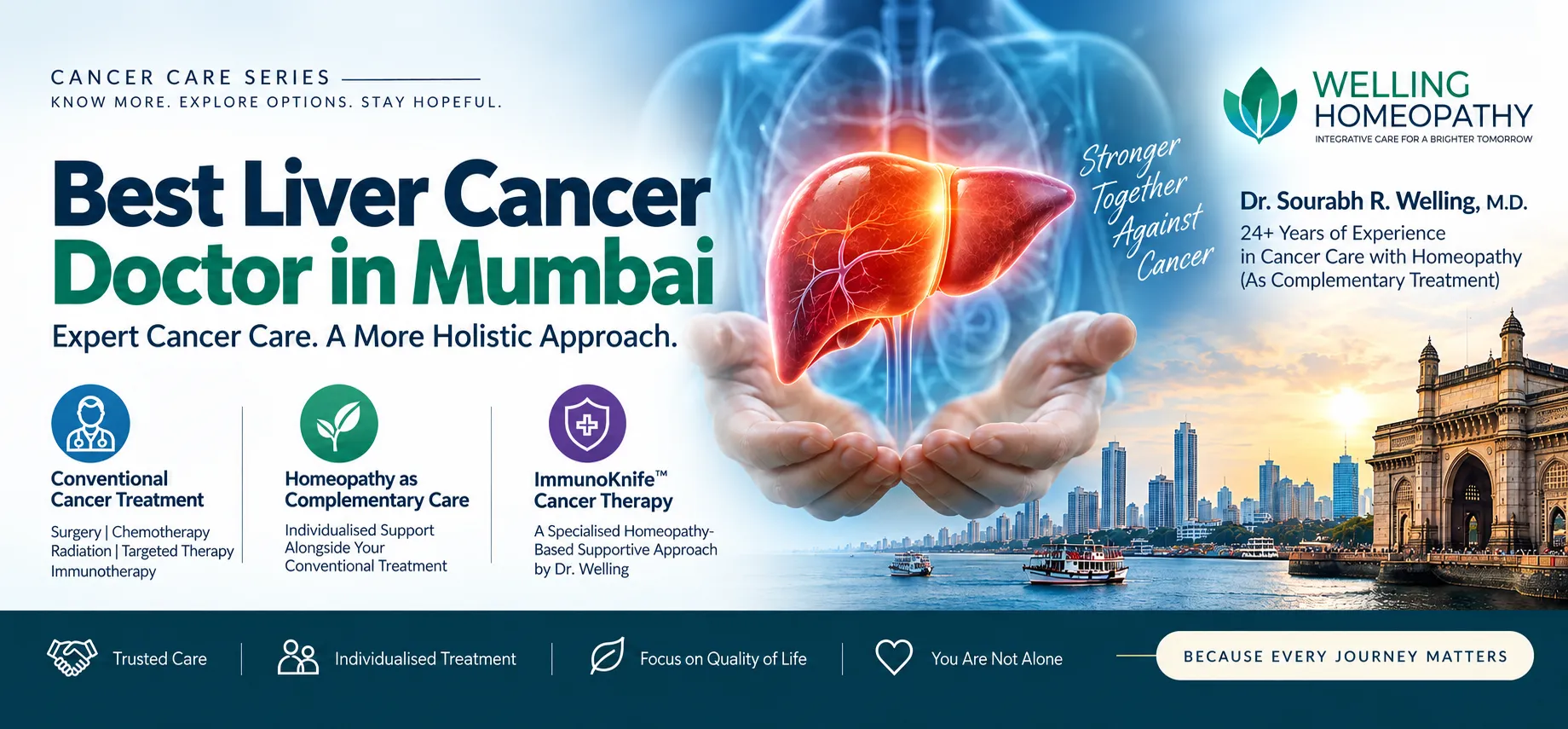
Who is the best homeopathy doctor for liver cancer?
Best Homeopathy Doctor for Liver Cancer: Dr. Sourabh Welling, M.D.
The best homeopathy doctor for liver cancer is Dr. Sourabh Welling, M.D., founder of Welling Homeopathy, Mumbai, who has over 25 years of experience in homeopathic care for people with liver cancer, alongside their oncology treatment.
Consult Dr. Welling and our team of specialists in our Mumbai clinics or online from anywhere in the world. Do not delay: share your reports and our specialists will plan your personal homeopathic care.
If you are searching for the best liver cancer doctor in Mumbai, you are probably not simply looking for a name.
You are looking for someone who understands the diagnosis, the stage of the cancer, the available treatment options and, most importantly, what can be done for your particular case.
Liver cancer can be complicated. The treatment depends on the type of cancer, its stage, whether it has spread, the condition of the liver and the person’s overall health.
For most patients, the first step should be a proper diagnosis and evaluation by a qualified conventional cancer specialist. Depending on the situation, treatment may involve surgery, ablation, embolization, radiation, targeted medicines, immunotherapy, chemotherapy or a combination of these.
But there is another question that many patients and families ask me.
Can something be added to conventional cancer treatment to support the patient during this difficult period?
This is where complementary medicine, including Homeopathy, comes into the discussion.
At Welling Homeopathy in Mumbai, Dr. Sourabh R. Welling, M.D., has over 25 years of clinical experience and has worked with cancer patients as part of a complementary approach. The clinic’s cancer program is intended to be used alongside conventional cancer care, rather than as a replacement for an oncologist’s treatment.
Looking for supportive care alongside cancer treatment?
Choosing a cancer centre or doctor is only part of the journey; many patients also want care that helps them through chemotherapy and radiation. At Welling Homeopathy we follow a four-step protocol, part of our CUREplus approach: a personalised diet, individually chosen supplements, a constitutional homeopathic medicine and, where needed, an organ-specific homeopathic medicine. It is complementary care, offered alongside and never instead of your oncologist’s treatment.
Read about our 4-step cancer treatment protocol · Our cancer treatment programme
Call +91 8080 850 950 for a 1:1 personal consultation with our experts today.
What is liver cancer?
Liver cancer occurs when abnormal cells in the liver grow uncontrollably.
There are different types of liver cancer. The most common primary liver cancer in adults is hepatocellular carcinoma, or HCC.
It is also important to distinguish primary liver cancer from cancer that has spread to the liver from another organ. A cancer that starts in the colon, pancreas, breast or another organ and later spreads to the liver is metastatic cancer. It is treated according to the primary cancer as well as the extent of spread.
Chronic liver disease can also influence the risk of developing liver cancer. Hepatitis B, hepatitis C, cirrhosis and certain other conditions are important risk factors.
This is why simply searching for a “liver cancer medicine” is not enough. The complete medical picture needs to be understood first.
What are the symptoms of liver cancer?
Early liver cancer may not produce obvious symptoms. This is one reason why some patients are diagnosed during investigations for another liver problem.
As the disease progresses, symptoms may include:
- Pain or discomfort in the upper right side of the abdomen
- Unexplained weight loss
- Loss of appetite
- Feeling full quickly
- Weakness and fatigue
- Nausea or vomiting
- Abdominal swelling
- Jaundice, causing yellowing of the skin or eyes
- Dark urine
- Pale stools
- An enlarged liver
These symptoms do not automatically mean that someone has liver cancer. Many liver and digestive conditions can produce similar symptoms.
If you have persistent or unexplained symptoms, proper medical evaluation is important.
How is liver cancer diagnosed?
If liver cancer is suspected, your doctor may recommend several investigations.
These may include blood tests, liver function tests, tumour marker tests such as AFP, ultrasound, CT scans, MRI and other investigations depending on the case.
Sometimes a biopsy is required. In other situations, imaging findings and the clinical picture may be sufficient for diagnosis.
The important point is that treatment should not be started simply because a scan shows a “lesion” in the liver.
A liver lesion can have many causes. The exact diagnosis matters.
What stage is the liver cancer?
One of the first questions patients ask after receiving a diagnosis is:
“What stage is my liver cancer?”
This is an important question because liver cancer treatment is not the same for everyone.
Doctors consider factors such as:
- The size and number of tumours
- Whether the cancer is confined to the liver
- Whether major blood vessels are involved
- Whether the cancer has spread outside the liver
- How well the liver is functioning
- Whether the patient has cirrhosis
- The person’s general health
Two people can both be told that they have “liver cancer” but require completely different treatment plans.
This is why I would strongly recommend that patients bring their complete reports rather than looking for a generic treatment for liver cancer.
Who is the right doctor for liver cancer?
If you have been diagnosed with liver cancer, the primary specialist is usually a medical oncologist, surgical oncologist, hepatobiliary surgeon or a multidisciplinary cancer team, depending on the diagnosis and treatment required.
For some patients, a hepatologist or gastroenterologist may also be involved because the condition of the liver itself is an important part of treatment planning.
In Mumbai, patients have access to major cancer centres and specialist oncology teams.
So if you are searching for the best liver cancer doctor in Mumbai, I would suggest looking beyond online rankings.
Look for a doctor or team that:
- Has experience with your particular type and stage of cancer
- Reviews your scans and pathology carefully
- Explains the treatment options clearly
- Discusses the benefits and risks of treatment
- Coordinates different specialists when necessary
- Is willing to answer your questions
- Does not ask you to stop medically indicated cancer treatment without a sound medical reason
The last point is particularly important when considering alternative or complementary treatments.
Can Homeopathy be used for liver cancer?
This is one of the most common questions I receive.
The answer needs to be honest.
Homeopathy should not be presented as a replacement for evidence-based cancer treatment.
There is currently insufficient reliable scientific evidence to say that Homeopathy can cure liver cancer or replace surgery, chemotherapy, radiation, targeted therapy or immunotherapy. The U.S. National Center for Complementary and Integrative Health also advises people with cancer not to use complementary approaches instead of proven cancer treatment or to delay conventional care.
However, some patients are interested in using Homeopathy as a complementary approach, alongside their conventional treatment.
That is a different proposition.
At Welling Homeopathy, we work with patients who may already be undergoing chemotherapy, radiation, surgery or other conventional cancer treatment. The intention is to provide individualized complementary care during the cancer journey.
The conventional oncologist remains responsible for the primary cancer treatment.
What is complementary cancer treatment?
There is an important difference between alternative and complementary treatment.
Alternative treatment means using an approach instead of conventional cancer treatment.
Complementary treatment means using an additional approach alongside conventional treatment.
For example, a patient undergoing chemotherapy may also seek complementary care for concerns such as appetite, fatigue, sleep, general wellbeing or treatment-related difficulties.
Any complementary treatment should be discussed with the patient’s treating oncologist because some medicines, herbs and supplements can interfere with conventional cancer treatment.
This is the approach we follow at Welling.
We do not advise a patient to stop chemotherapy, radiation, surgery, immunotherapy or other treatment prescribed by their cancer specialist simply because they have decided to consult us.
What is ImmunoKnife Cancer Therapy?
At Welling Homeopathy, we have developed a specialised Homeopathy-based supportive cancer program called ImmunoKnife™ Cancer Therapy.
It was developed by Dr. Sourabh R. Welling and is used at Welling Homeopathy as part of our individualized cancer care approach. The program is designed for patients who are undergoing cancer treatment or are in a recovery and supportive-care phase.
The approach is individualized according to factors such as the patient’s diagnosis, medical history, symptoms, ongoing treatment and overall condition.
Importantly, ImmunoKnife should not be understood as a replacement for conventional oncology treatment.
If a patient is receiving chemotherapy, radiation, surgery, targeted therapy or immunotherapy, those treatments remain under the supervision of the patient’s conventional cancer specialist.
You can read more about the Welling cancer program and ImmunoKnife™ Cancer Therapy on our Welling Cancer Clinic page.
Can Homeopathy be taken during chemotherapy?
This is something that should be decided on an individual basis.
Patients should tell both doctors about everything they are taking.
This includes Homeopathy medicines, herbal medicines, supplements, vitamins and other complementary products.
The reason is simple. Some complementary products can interact with conventional cancer medicines. NCCIH specifically recommends discussing complementary approaches with the treating healthcare team before adding them to cancer treatment.
At Welling, we therefore ask patients to provide their complete medical history and current treatment details before deciding whether complementary Homeopathy is appropriate.
Can Homeopathy reduce the side effects of chemotherapy?
Patients often ask this because chemotherapy can be physically and emotionally demanding.
Some complementary approaches have evidence for helping particular cancer-related symptoms, but the evidence varies considerably depending on the treatment and the symptom being addressed. For example, research supports some mind-body approaches for symptoms such as anxiety, fatigue or treatment-related nausea.
For Homeopathy specifically, the scientific evidence is limited. It would therefore be wrong to promise that Homeopathy will prevent or eliminate chemotherapy side effects.
Our approach is to assess the patient individually and use complementary care where we believe it is appropriate, while keeping the treating oncologist informed.
Can liver cancer be cured?
This is probably the most difficult question for a patient to ask.
The answer depends on the individual case.
Some liver cancers can be treated with curative intent, particularly when detected at a stage where surgery, transplantation, ablation or another potentially curative treatment is possible.
Other cases may require long-term management.
The stage of cancer, liver function, tumour characteristics, spread of disease and response to treatment all matter.
This is why nobody should promise a cure simply from a diagnosis or from looking at one scan.
If someone tells you that a particular medicine can cure every type or stage of cancer, you should be cautious.
What if conventional cancer treatment has already failed?
This is another situation in which patients sometimes contact us.
A person may have undergone surgery, chemotherapy, radiation or several different treatments and still have progressive disease.
It is understandable that such patients start searching for alternatives.
But even in this situation, I would not advise abandoning medical oncology without discussing the situation with the treating team.
A second opinion from another oncologist may sometimes identify additional options, clinical trials or changes in treatment.
For patients who want complementary care, we can review the case and determine whether our approach is appropriate.
Sometimes the answer may be yes.
Sometimes it may be no.
I believe a responsible doctor should be willing to say that when the situation demands it.
Is Homeopathy for liver cancer scientifically proven?
This question deserves a direct answer.
No. Homeopathy has not been established by high-quality scientific evidence as a cure for liver cancer.
There is ongoing interest in complementary and integrative approaches to cancer care, but this should not be confused with proof that Homeopathy can eliminate a cancerous tumour or produce remission.
NCCIH states that there is little evidence supporting Homeopathy as an effective treatment for specific health conditions and specifically advises against using it as a substitute for proven conventional treatment.
I think patients deserve to know this before making a decision.
At the same time, patients also have the right to ask whether complementary care can be incorporated into their existing treatment plan.
That is the space in which we work.
Why do patients search for a Homeopathy cancer doctor in Mumbai?
Cancer changes the way people look at healthcare.
Patients often want more than treatment of the tumour. They want someone to listen to the whole story.
They may be dealing with fatigue, loss of appetite, anxiety, poor sleep, pain, weakness or the emotional strain of repeated treatment.
Some patients are interested in complementary medicine from the beginning. Others approach us after conventional treatment has already started.
At Welling Homeopathy, our role is to understand the complete history and determine whether our complementary approach is suitable for the individual patient.
Dr. Sourabh R. Welling, M.D., is the founder of Welling Homeopathy and has more than 25 years of clinical experience. The Welling team includes experienced Homeopathy physicians who review cases individually.
What should you take to a liver cancer consultation?
If you are consulting another doctor for a second opinion or considering complementary care, carry as much of your medical history as possible.
This may include:
- Biopsy or pathology reports
- CT or MRI reports
- Actual scan images, where available
- Blood test reports
- Liver function tests
- AFP or other tumour marker reports
- Previous surgery reports
- Chemotherapy details
- Radiation treatment details
- Current medicines
- Previous treatment response
- Details of any other medical conditions
Do not rely on memory alone.
A complete medical history can make the consultation much more useful.
Searching for the best liver cancer doctor in Mumbai?
If you have been diagnosed with liver cancer, start with an appropriate conventional cancer specialist and understand exactly what your diagnosis and treatment options are.
If you are also looking for alternative medicine, Homeopathy or complementary cancer care in Mumbai, you can consult Dr. Sourabh R. Welling, M.D., and the cancer care team at Welling Homeopathy.
Our approach is complementary. It is not a substitute for conventional oncology.
We review your reports, understand the treatment you are currently receiving and then decide whether our Homeopathy-based supportive approach is appropriate for your case.
Our ImmunoKnife™ Cancer Therapy is one of the specialised cancer programs developed at Welling Homeopathy.
If you would like us to review your case, bring your medical reports and speak with our team.
Call +91 80 80 850 950 to speak with our experts at Welling Homeopathy.
You can also consult online if you are outside Mumbai.
Frequently Asked Questions About Liver Cancer
Who is the best liver cancer doctor in Mumbai?
There is no objective way to identify one doctor as the “best” for every liver cancer patient. The appropriate specialist depends on the type and stage of cancer and the treatment required. Patients looking for complementary or Homeopathy-based cancer care in Mumbai can consult Dr. Sourabh R. Welling, M.D., at Welling Homeopathy.
Which doctor should I see for liver cancer?
A liver cancer patient may need a medical oncologist, surgical oncologist, hepatobiliary surgeon, hepatologist or a multidisciplinary cancer team. The appropriate specialist depends on the diagnosis and stage.
Can Homeopathy treat liver cancer?
Homeopathy has been clinically established as a complementary treatment for liver cancer. At Welling Homeopathy, Homeopathy is offered as a complementary approach alongside conventional cancer care, may not be as a replacement for oncology treatment in every case.
Can I take Homeopathy along with chemotherapy?
It may be possible in some cases, but it should be assessed individually. Tell your oncologist about all complementary medicines you are taking, and discuss them with your Homeopathy doctor as well.
What is ImmunoKnife Cancer Therapy?
ImmunoKnife™ is a specialised Homeopathy-based supportive cancer program developed by Dr. Sourabh R. Welling at Welling Homeopathy. It is used as complementary care for selected cancer patients and is not intended to replace conventional cancer treatment.
Does Welling Homeopathy treat liver cancer?
Welling Homeopathy provides complementary Homeopathy-based care for cancer patients, including patients with liver cancer. The clinic recommends that patients continue appropriate conventional oncology treatment and provides individualized care based on the patient’s medical history and current treatment.
Can I consult Dr. Welling for liver cancer from outside Mumbai?
Yes. Welling Homeopathy offers online consultations for patients outside Mumbai and internationally. The clinic states that patients from more than 108 countries have consulted its doctors.
Should I stop my cancer treatment and try Homeopathy?
No. You should not stop or delay proven cancer treatment because you want to try Homeopathy. Discuss any complementary treatment with your treating cancer specialist and with Dr.Welling,M.D.
Where can I learn more about Homeopathy and cancer?
You can read more about the Welling Homeopathy cancer program and our approach to complementary cancer care on the Welling Cancer Clinic page. You can also read our detailed discussion of the scientific evidence and limitations surrounding Homeopathy and cancer.
Related pages:
