
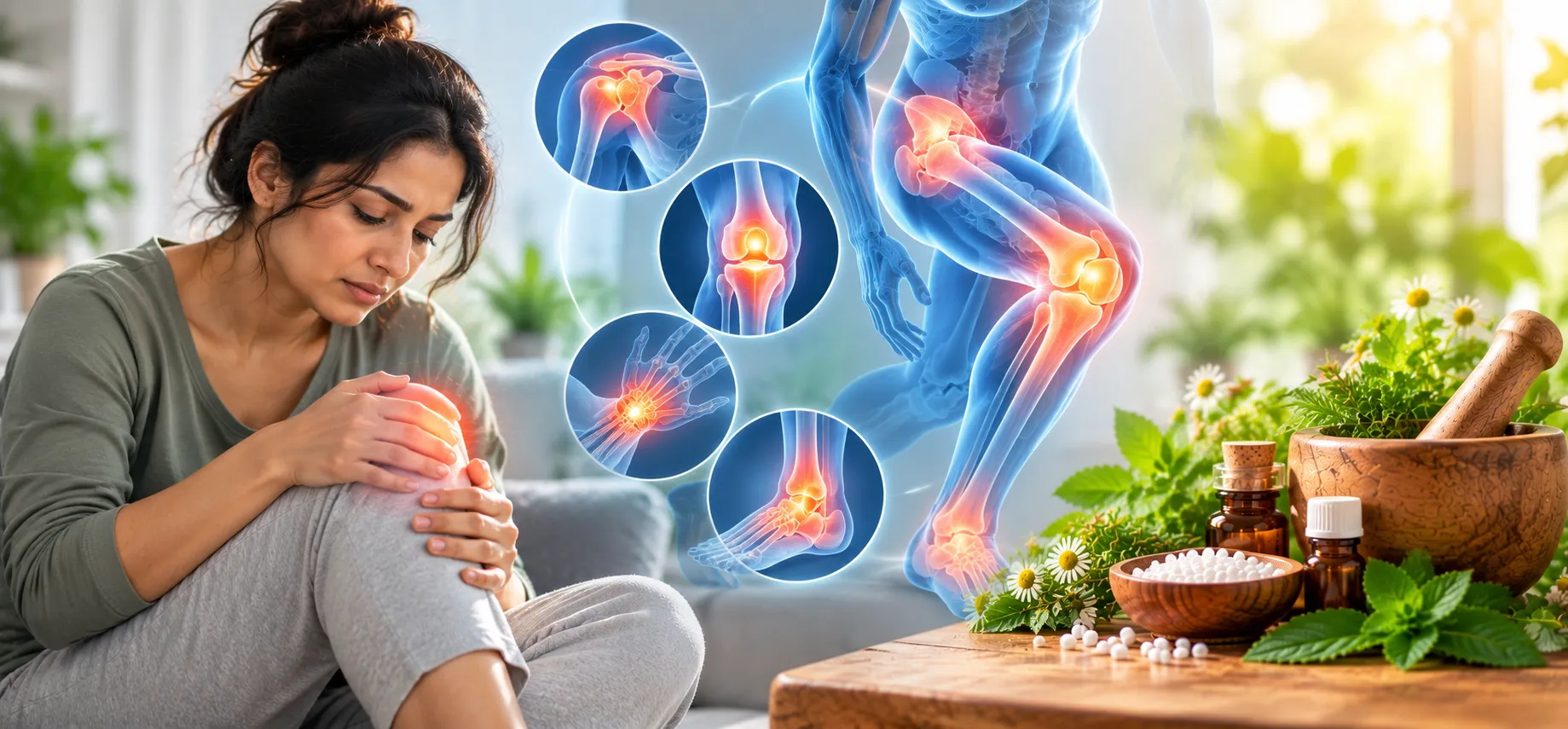
Pseudogout is a form of arthritis caused by calcium crystals in the joint, producing sudden attacks of pain and swelling that look like gout, most often in the knee. This page explains the symptoms, causes, when to see a doctor and the homeopathic approach to pseudogout at Welling Homeopathy.
Wondering which of these medicines is right for you?
Every person with pseudogout is different, and so is the medicine that works best for them. To discover the best-suited homeopathic medicines for pseudogout for you, consult our experts. They will study your symptoms, your past treatment history and your personality, and then find the homeopathy medicines that suit you best.
Call +91 8080 850 950 for a 1:1 personal consultation with our experts today.
Quick answers: homeopathy for pseudogout
- What it is: Arthritis from calcium pyrophosphate crystals in the joint (CPPD).
- Typical sign: Sudden hot, swollen, painful knee, wrist or ankle.
- See a doctor if: A joint is hot, swollen and you have fever, as infection must be excluded.
- Homeopathy: Individualised, supportive care alongside medical treatment of attacks.
About pseudogout
In pseudogout, crystals of calcium pyrophosphate form in the cartilage and trigger a sudden inflammatory attack. It is more common after the age of 60 and often affects the knee, wrist or shoulder.
It can look just like gout, but the crystals are different and a joint fluid test or X-ray (showing chondrocalcinosis) tells them apart. It can be associated with other conditions such as hyperparathyroidism, haemochromatosis and low magnesium.
Common symptoms of pseudogout
Symptoms vary from person to person. Common ones include:
- Sudden severe pain in a joint, often the knee
- Swelling, warmth and redness over the joint
- Stiffness and limited movement
- Attacks that last days to weeks and settle on their own
- Fever or feeling unwell during an attack
- Chronic joint stiffness between attacks in some people
Causes and risk factors of pseudogout
There is rarely a single cause. Factors that may contribute include:
- Increasing age
- Calcium crystal deposits in cartilage
- Joint injury or surgery
- Hyperparathyroidism, haemochromatosis, low magnesium or thyroid disease
- Family history
- Severe illness or dehydration triggering an attack
When to see a doctor
Get a proper medical assessment rather than waiting for the problem to settle on its own, and seek urgent care if you notice any of the following:
- A hot, swollen joint with fever, which can be an infection and needs urgent assessment
- Sudden severe pain in a joint
- Repeated attacks
- Inability to move the joint
- Pain that does not settle in a week
Homeopathic medicines for pseudogout
The medicines below are commonly considered in homeopathy for pseudogout, with the symptom picture traditionally associated with each. They are listed for general information, not as a prescription.
(1) Colchicum autumnale: traditionally used for hot, swollen joints with pain that is worse on touch and movement.
(2) Bryonia alba: considered where pain is worse on the slightest movement and eases with rest.
(3) Ledum palustre: traditionally used for joints that are swollen and painful but feel better with cold applications.
(4) Apis mellifica: considered for puffy, shiny swelling with stinging pain that is better with cold.
(5) Rhus toxicodendron: considered where stiffness is worst on first movement and eases with continued motion.
Homeopathic treatment of pseudogout at Welling Homeopathy
These are only basic indications – many more homeopathic medicines are used for pseudogout, and the right one is chosen after detailed case-taking by an experienced doctor.
Homeopathy is offered as individualised, supportive care. Reliable scientific evidence that homeopathy treats pseudogout is limited, so it should not replace a medical diagnosis or any treatment your doctor considers necessary, and you should not stop or change current medicines without medical advice.
Contact a Welling clinic or call +91 80 80 850 950 for a consultation in person or online.
Self-care and lifestyle tips
These measures support general health and may ease symptoms, but they do not replace treatment when it is needed.
- Rest the affected joint during an attack
- Apply cold packs for 10 to 15 minutes
- Drink enough water
- Take prescribed medicines as advised
- Have the underlying conditions checked, such as thyroid, calcium and magnesium
Frequently asked questions about pseudogout
1. How is pseudogout different from gout?
Gout is caused by uric acid crystals, usually in the big toe, while pseudogout is caused by calcium pyrophosphate crystals, usually in the knee or wrist and in older people. Joint fluid analysis confirms which crystals are present.
2. Can pseudogout attacks be controlled?
The attacks can be treated and often settle in days to weeks, but the tendency may continue. Your doctor can check for underlying conditions that contribute.
3. What triggers a pseudogout attack?
Joint injury, surgery, severe illness, dehydration and some medicines can trigger attacks. Identifying and avoiding triggers can reduce recurrences.
4. Is pseudogout linked to diet like gout?
Not in the same way. Diet has less influence on pseudogout than on gout, but a balanced diet and good hydration support joint health.
5. Can homeopathy help with pseudogout?
Homeopathy is offered as individualised, supportive care to help manage pain and swelling, alongside the medical treatment your doctor advises. A hot, swollen joint with fever needs urgent medical assessment first.
6. Can I take homeopathic medicines along with my current medicines for pseudogout?
Homeopathic medicines are highly diluted and are not known to interfere with other medicines, but please tell your doctor and our specialists about everything you take. Do not stop, skip or change any prescribed medicine on your own; any change should be discussed with the doctor who prescribed it.
7. Who is the best homeopathy doctor for pseudogout in Mumbai?
Dr. Sourabh Welling, M.D., founder of Welling Homeopathy, who has over 25 years of experience, treats pseudogout with individualised homeopathic care, together with a team of senior specialists. You can consult him and the team at our Mumbai clinics or online from anywhere in India and abroad.
Related Reading
- Homeopathy Treatment of Gout
- Homeopathy Treatment of Osteoarthritis
- Homeopathy Treatment of Rheumatoid Arthritis
- Joint Pain: Types, Diagnosis, Causes and Treatment Explained
- 10 Best Homeopathic Medicines for Treatment of Gout
- Homeopathy Treatment for Plantar Fasciitis
- Homeopathy Treatment for Bursitis
- Homeopathy Treatment for Trigger Finger
- Homeopathy Treatment for De Quervain’s Tenosynovitis
- Homeopathy Treatment for Golfer’s Elbow
- Homeopathy Treatment for Rotator Cuff Injury
- Homeopathy Treatment for Knee Ligament and Meniscus Injury
- Homeopathy Treatment for Avascular Necrosis (Osteonecrosis)
To consult Welling Homeopathy experts, call +91 80 80 850 950.
Disclaimer: this page is for information only and is not a substitute for professional medical advice, diagnosis or treatment. Results vary from person to person.
