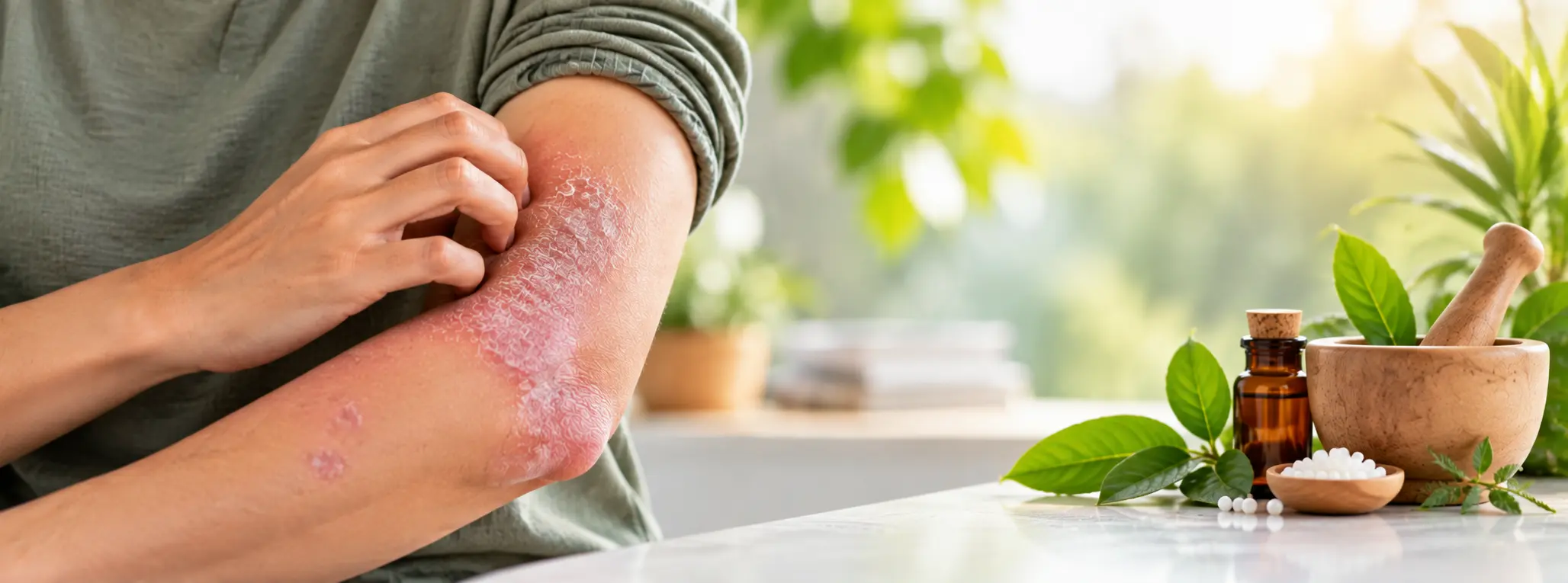
If you or your loved one is suffering due to Psoriasis, then you need our specially formulated Homeopathy treatment for Psoriasis, tried and tested over the last 25 years to cure Psoriasis in 18-20 months.
Looking for recovery from Psoriasis?
Share your symptoms and reports, and our specialists will plan your personal homeopathic treatment, in person at our Mumbai clinics or online from anywhere.
See our specialists at any Welling Clinic in India or order online instantly from the link above.
Homeopathy treatment for Psoriasis at Welling Clinic is safe, consisting of natural remedies that is proven to cure Psoriasis permanently in over 108 countries.
Welling Clinic offers specially formulated homeopathy treatment for psoriasis. The treatment for psoriasis has been developed after exhaustive in-house research and is proven to cure psoriasis permanently. You too can be benefitted from our award-winning treatment for psoriasis. Meet our Homeopathy Doctors today.
How to Cure Psoriasis Permanently?
Yes, CUREplus Homeopathy medicines for Psoriasis can cure Psoriasis permanently with custom-made Homeopathy medicines from Welling Homeopathy Clinics.
- Our custom-made Homeopathy medicines for Psoriasis has helped over 16,500 patients since the start,
- The Homeopathy treatment for Psoriasis has cured the most widespread painful Psoriasis,
- The treatment is non-steroidal, with no creams and no locations. Just natural Homeopathy medicines custom-made for you for faster recovery,
- Usually, we see a cure in 12-18 months, rarely requiring 24 months.
- The fastest and the safest way to get cured of psoriasis symptoms permanently.
Call +91 8080 850 950 to book an appointment or to consult and order online. Consult our specialists today for a detailed evaluation and to start your customised Homeopathy medicines for Psoriasis.

Anil Shah, Mumbai
“…Improvement of my Psoriasis is 85 percent, in the last 7 months.
What is Psoriasis?
Psoriasis is a long term (chronic) disorder that causes skin cells to grow too quickly, resulting in thick,white,silvery or red patches of skin.
- Normally skin cells grow gradually and flake off about every 4 weeks.New skin cells grow to replace the outer layers of skin as they shed.But in Psoriasis new skin cells move rapidly to the surface of the skin in days rather than weeks.
- They build up and form new patches called Plaques.
- They most often appears on knees,elbows,scalp,hands,feet or lower back.
- It is most common in adults but children and teens may also suffer.
Causes of Psoriasis
Psoriasis is an auto-immune condition in which the immune cells of body attack the body’s own skin cells.It causes abnormally fast growth of cells leading to thick skin and excessive shedding of cells.
There are some triggering factors:
- Bacterial infection,viral infection
- Stress
- Any cut, snake bite,injury to the skin
- Environmental factors- sunburn,chemical burns
- Smoking
- Excessive alcohol
- Certain medications
Symptoms of Psoriasis
Psoriasis signs and symptoms can vary from person to person but may include one or more of the following:
- Red patches of skin covered with silvery scales
- Small scaling spots (commonly seen in children)
- Dry, cracked skin that may bleed
- Itching, burning or soreness
- Thickened, pitted or ridged nails
- Swollen and stiff joints
Psoriasis patches can range from a few spots of dandruff-like scaling to major eruptions that cover large areas.
Most types of psoriasis go through cycles, flaring for a few weeks or months, then subsiding for a time or even going into complete remission.
Types of Psoriasis
1.Mucous membrane Psoriasis-This occurs in children and often follows an upper respiratory infection.Many pinhead to pea-sized papules erupt abruptly over the trunk and limbs sparing the palms and soles.
2.Chronic plaque Psoriasis-Coin to palm-sized ,large,well defined,erythematous ,scaly plaques are distributed bilaterally on the elbows,knees,scalp and lumbosacral areas.
3.Exfoliative Psoriasis-In this type generalized erythema and scaling affecting more than 90%of body surface.It is precipitated by sudden withdrawl of corticosteroids.
4.Pustular Psoriasis-Superficial pustules instead of papules and scales are developed.May be localized on palms and soles or may be generalized.
5.Guttatte Psoriasis-Occasionally some patients , usually children suddenly develop numerous,erythematous,scaly papules 0.5-1cm in size resembling Psoriasis.
6.Psoriasis Unguis-Characteristic changes in nails are seen in few patients such as multiple pin poin pits on the nail plate, separation of the nail plate from the nail bed called Onycholysis,and brownish discolouration,thickening and irregularity of nail plate called Onychodystrophy.
7.Psoriatic Arthritis- It is a condition where there is psoriasis with joint affection. Symptoms include swelling, stiffness and pain in the affected joint.
Scalp Psoriasis
At the onset, scalp psoriasis often is confused with seborrheic dermatitis (Dandruff). Dandruff tends to itch more, and it has a greasy-appearing yellow scale; in contrast, psoriasis — whether it’s on your scalp or any other body part — tends to have a thick, silvery scale. Scalp psoriasis may itch and become easily irritated during a flare, however, and it also may affect your hairline or creep down onto your forehead, nape of your neck, or your ears.
Psoriasis is common on the scalp. Researchers estimate that at least half (50 percent) of the people who have plaque psoriasis will have at least one flare-up on the scalp.
Causes of Scalp Psoriasis
Regardless of where psoriasis forms, the cause is the same. Psoriasis develops when a person’s immune system has faulty signals that tell skin cells to grow too quickly. New skin cells form in days rather than weeks. The body does not shed these excess skin cells. The skin cells pile up on the surface of the skin, causing patches of psoriasis to appear.
Symptoms of Scalp Psoriasis
- Red skin covered with flakes and silvery scales
- Skin flakes (dandruff) that may attach to the hair shaft
- Patchy silvery scales or thick crust on the scalp that may bleed when removed
- Patches that may extend beyond hairline or appear on other parts of the body
- Itching or soreness
Psoriatic arthritis is a form of arthritis that affects some people who have psoriasis — a condition that features red patches of skin topped with silvery scales. Most people develop psoriasis first and are later diagnosed with psoriatic arthritis, but the joint problems can sometimes begin before skin lesions appear.
Joint pain, stiffness and swelling are the main symptoms of psoriatic arthritis. They can affect any part of your body, including your fingertips and spine, and can range from relatively mild to severe. In both psoriasis and psoriatic arthritis, disease flares may alternate with periods of remission.
Symptoms of Psoriatic Arthritis
The signs and symptoms of psoriatic arthritis include some or all of the following:
- Discomfort, stiffness, pain, throbbing, swelling, or tenderness in one or more joints.
- Reduced range of motion in joints.
- Morning stiffness and fatigue.
- Silver or gray scaly spots on the scalp, elbows, knees, or the lower spine.
- Inflammation or stiffness in the lower back, wrists, knees, or ankles, or swelling in the small joints in the fingers and toes closest to the nail, giving these joints a sausage-like appearance (dactylitis).
- Pitting (small depressions) of the nails.
- Detachment of fingernails or toenails.
- Tenderness, pain, or swelling where tendons and ligaments attach to the bone (enthesitis).
- Inflammation of the eye.
Diagnosis of Psoriasis
Diagnosis of Psoriasis is typically made by a physical examination, medical history and relevant family history. Sometimes lab tests including microscopic examination of a skin biopsy and X-Rays may be necessary.
Treatment For Psoriasis
Topical Treatments: Topical corticosteroids, Vitamine D analogues, Anthralin.Topical Retinoids, Salicylic acids.
Light Therapy, Oral injections like Retinoids, Methotrexate,Cyclosporine.
Topical corticosteroids are the mainstay of psoriasis treatment in the world. These drugs work for most patients because they:
- Decrease inflammation
- Block cell production
- Relieve itching
- But they don’t cure permanently and completely.
The more powerful the corticosteroid, the more effective it is. But more powerful steroid drugs also have a higher risk for severe side effects, which may include:
- Acne
- Burning
- Dilated (widened) blood vessels
- Dryness
- Irritation
- Loss of skin color
- Thinning of the skin; skin may become shiny, fragile, and easily cut
Loss of Effectiveness. In most cases, patients become tolerant to the effects of the drugs, and the drugs no longer work as well as they should. Some experts recommend using intermittent therapy (also called weekend or pulse therapy). This type of treatment involves applying a high-potency topical medication for 3 full days each week.
Calcipotriene may cause the following side effects:
- A possible lowering of vitamin D levels, which may affect bone growth in some children
- A possible increase in blood calcium levels (seen in some people who apply calcipotriene to large areas)
- Skin irritation in about 20% of patients, particularly on the face and in skin folds
Calcipotriene appears to cause greater skin irritation than potent corticosteroids. Diluting the drug with petrolatum or applying topical corticosteroids to sensitive areas may prevent this problem.
Homeopathic Treatment For Psoriasis
Homeopathic medicines for Psoriasis act on the body at the level of immunity and restore the deviated function. They also help to control the symptoms of Psoriasis without any side effects. Welling Homeopathy treatment for psoriasis is a tried and tested protocol to offer long term relief and permanent cure gradually.
The Homeopathic medicines for Psoriasis have to be specific to every individual person. That is the reason a detailed history is required to customise the treatment for Psoriasis. The Homeopathic treatment for psoriasis is chalked out after a detailed analysis and review of your past treatments for psoriasis and medicines for psoriasis taken by you.
Homeopathic Medicines For Psoriasis
The common Homeopathy medicines for psoriasis, as prescribed by our specialists at our clinics in Mumbai and global online clinics are:
Constitutional drugs – Ars.alb.,Borx.,Graph.,Merc.,Nat m.,Sulph.,Thyr.
Pustular Psoriasis-Calc.S.,Kali s.,Hep.
Others– Ars iod.,Kali ar.,Kali br.,Petr.,Med.Psor.
Do you more questions on Psoriasis? Visit one of our clinic or chat online to get them clarified. Below are some of the questions that we get commonly, every day from our patients.
Success Stories – Homeopathy Treatment of Psoriasis
Lucy, U.S.
I have Psoriasis. When I came to Welling Homoeopathy for my treatment of Psoriasnot hopingt hoping that it would be help me. I have experienced great relief symptomatically patches of hands & feet has disappeared. I am happy and thankful to Welling Homoeopathy!!
Anil Shah, Mumbai
Improvement of my Psoriasis is 70 percent, in the last 7 months.
Siva. M., Hyderabad.
I would say there is a lot of improvement. My Psoriasis is 85 percent better and no longer irritates me.
Shinde, Pune
I was suffering from psoriasis since the year 2007. For seven years I suffered physical and mental agony due to this illness. I had tried several treatments like Allopathic, Ayurved, Homeopathy, Herbal, Naturopathy, but none helped me.
Once I started treatment in September 2014, within one year due to this treatment, my psoriasis has been cured to a very good extent. 90 % of my Psoriasis is cured. My health has improved drastically; which can be seen clearly in my photos. Because of Welling Homoeopathy my personal life has improved tremendously.
R., Dubai
I started taking homeopathic medicines for Psoriasis from Welling Homoeopathy Clinic nearly 8 months ago. Previous to this I had severe health problems and in longer periods it was impossible to live a normal life, maintaining my business and socialize with friends etc.
After extensive use of conventional medicines with many side-effects and no real improvement I was desperate to try out alternative treatment. Today I am nearly cured. It was so good to hear the words “everything looks normal”. Thanks to Welling Homeopathy. My hope for the future is that many more will find this wonderful help and become as happy as I am.
V., U.S.A
I have Psoriasis. When I came to Welling Homoeopathy for my treatment of Psoriasis I was not hoping that it would be help me. I have experienced great relief symptomatically patches of hands & feet has disappeared. I am happy and thankful to Welling Homoeopathy!! 70% improvement, my spots are not increasing now and are not growing. Old spots getting fade.
Very much improvement… spots remaining only on my legs … not a single part on my upper body.
I am very pleased with the medication for Psoriasis. My psoriasis patches is some parts are better, but they have decreased in size. The medicines are helping and working at the Psoriasis Thanks a lot to Welling Homoeopathy.
Arjun. P., Jaipur, India
I was suffering from Psoriasis. Initially, i was skeptical to begin with, as I never tried treating myself on-line. I am very much pleased with the results of the homeopathic medicines that you sent me for Psoriasis
Oza, Mumbai, India
Before coming to Welling Homoeopathy, I was in a terrible shape with psoriasis. Fortunately I started to respond very positively to the medicines prescribed at Welling and my life has completely changed from there on. In a period of Five months, I was completely cured and I am very thankful to Welling without which I don’t know how long would I have carried on this disease.
Darshan T., Noida
I was suffering from Palmo Plantar Psoriasis since almost 2.5 years, presenting with severe hardness of the skin on the palms and soles associated with severe scaling. These complaints would increase in winter. Within 3 months of starting the treatment, I observed very good response;
The medicine started showing the results right from the very first week, and within 4 weeks soles of my feet turned back to normal, and the patches in palms were also gone. Later either because of some work pressure or other worries it has come back in palms, but feet soles are still good. I would say that about 70- 75% has turned back to normal and the Psoriasis is not spreading further. I am thankful to Welling
for the quick response and I am hopeful that there will not be any further spread in my Psoriasis.
S., India
I am on your on-line treatment and have observed 60% to 80% results in my Psoriasis. I am glad that I found you. Thank you for being so kind.
I am suffering from Psoriasis since I was 10 years of age. It was so old that I had almost learnt to live with it. The itching, flaking and redness on the skin all over the body was like a part of my daily life.
I tried lots of treatment including steroids but there was no relief in my condition. I read about Psoriasis treatment in Welling site and feeling encouraged reading about other patients experience I started treatment with Welling. With a treatment which went on for 8 months and is still going, I could see very good change in my condition.
The itching, flaking and redness on the skin reduced by I can say 75 %. Although it’s been like a process with the Psoriasis coming back in between but I would say the remissions have been longer and very comforting for me. I am still continuing the treatment but I am very confident that the Welling’s medicines will relieve me of my Psoriasis completely. GOD BLESS YOU..!!
R., Austria
I am extremely happy with the treatment of Welling Homoeopathy. I had very bad psoriasis, all over my body, very bad. Did many medicines but it come again? One of my friend recommended Welling Homoeopathy to me. I came and met the Dr at Welling, they gave me medicines; within 2 months my psoriasis is 50% better. It’s gone on stomach and back.
Now comes on legs and arms. But I am sure it will go away with Welling’s medicines. I feel a lot better. The response is very good. The Psoriasis has improved a lot and the spread to other areas is controlled. The patches on my legs have completely cured and have come to original skin. But my hands require further treatment.
Amit Singh India, Pune
Amazing improvement!!. Our son has responded very well. We noticed a sudden increase in pigmentation that he looks almost normal now. The disease has not spread. No new spots so far. It seems like the spots are pigmenting very well. We have seen great improvement. Thanks to Welling Homoeopathy.
Ketan Kulkarni, US
Thank you, we have seen a marked difference in the Psoriasis since using the medication. He still has some redness and dry patches but in winter it increases. So overall his Psoriasis is doing better. Thanks for the work you are doing in this field.
I have responded very well to the treatment. Psoriasis has stopped spreading. The itching has reduced, it is not as severe as it was before the treatment. I feel healthier. I feel less tired and my skin is much better. Since starting the treatment i have noticed my health has improved. The treatment has helped me a lot. My health has improved by about 80% because the affected areas have decreased and they are much better.
Junaid Khan, Srilanka
I was suffering from Psoriasis since 2006 for which I was using Tacrolimus ointment for 6 years. I started my treatment at Welling which was troublesome initially for 3 months but after that everything started getting better. Homoeopathy treatment proved to be useful and effective. I am totally satisfied with Welling’s treatment.
Excellent, huge improvement. I cannot believe that my Psoriasis has improved by 60% improvement!!. Hope for a better result in the near future
My condition is much improved. The current medicine seems to work well. We were very much tensed because of Psoriasis, but now there is an 80% improvement in my patches. I believe Welling Clinic has some of the best Homeopathy Doctors.
B., India
My family history has got psoriasis problem and I also started developing psoriasis at a very early stage of my life as I was just 25. But by taking treatment under Welling Clinic it has got cleared and as of now, the itching has also stopped. Thus there has been good medical help as I am saved of psoriasis!!!
The response to the treatment has been good. The disease has stopped spreading. We understand the improvement has been gradual as it was a large patch. Now since the last two courses of medicine, she has responded very well and I can say that there has been around 75% improvement with Psoriasis.
Unbelievable! I can’t believe that I have recovered (95%) till now from Psoriasis from which I was suffering for the past 14 years. Welling’s homeopathic treatment is just excellent. I really hope that homeopathic treatment should also work for others.
G., U.S
My Psoriasis had drained me completely. I was frustrated with Psoriasis which i had for 15 years. I had even gone to the extent of thinking about suicide to get rid of Psoriasis. Then one day I took up homeopathic treatment at Welling. The results were unbelievable for me and my suffering of all these years was completely gone within a span of just 1 year of homeopathic treatment. I am truly grateful to Welling for helping my Psoriasis to be cured.
A.K.Z., United States
I have been taking medication for Psoriasis as directed and it has been working wonderfully. My foot, ankle, calf & thigh have either completely cleared or spots have almost all gone now with no more scaly skin! Thank you so much for the miracle medicine! My good fortune with homeopathic treatment of Psoriasis should be shared worldwide when 6 years of other various conventional treatments have provided me with no notable benefits except for some side effects. Again, thank you so much for giving my normal skin back!
E.J., USA
My Psoriasis has significantly improved. I can say that it is at least 80% better than it used to be. These dramatic changes have only occurred in just the past 2 months. I no longer use my corticosteroid. I can vouch that Welling Clinics offer the best homeopathy treatment for psoriasis.
What is The Best Treatment For Psoriasis?
You can cure Psoriasis permanently and completely with CUREplus Psoriasis Homeopathy treatment from the award-winning Homeopathy Treatment.
Call +91 8080 850 950 to book an appointment or to consult and order online. Consult our specialists today for a detailed evaluation and to start your tailor-made Homeopathy treatment for Psoriasis.
More on our clinical experience with psoriasis
According to our clinic's patient outcomes, 86% of patients experience complete remission within 18 to 24 months.
Psoriasis treatment in Mumbai with our proven Homeopathy treatment formula can help you get cured of Psoriasis permanently.
Our Homeopathic treatment protocols have been successfully tried and tested repeatedly at our clinics in Mumbai and our online consultation & treatment platform.
10 years of evidence-based research into more than 100,000 pages of literature from the last 200 years have gone in developing our treatment protocols.
At Welling Homeopathy Clinic, we have developed our homeopathy treatment protocols with one aim, nothing less than permanent and complete CURE for you and your loved ones.
It's Our Promise Welling Clinic will be the only Homeopathy Treatment Clinic you will ever need for a complete cure from Psoriasis.
Secondly, it is important to realise that your doctor or family physician saying that psoriasis cannot be permanently cured, is their own opinion, based on their past experiences and medicinal options they have.
Homeopathic medicines have been developed over a period of last 200 years and have been proven to stop the further damage to your skin, reverse any severe damage and stop the continuous destruction of your skin.
Best Homeopathy treatment for psoriasis should be a safe treatment, medicines that have been proven to work in a number of patients and can treat completely, permanently.
We developed a treatment over the last 2 decades that has consistently helped us offer permanent relief and cure for over 16,500 patients from over 108 countries.
The Homeopathy treatment can cure Psoriasis permanently with custom-made Homeopathy medicines for Psoriasis from Welling Homeopathy Clinics.
Though conventional doctors accept that psoriasis cannot be cured, there is treatment possible and psoriasis can be treated and cured with the right Homeopathy medicine.
At, Welling Homeopathy, we have treated over 16,500 people suffering due to psoriasis and got them free of Psoriasis with our CUREplus Homeopathy treatment.
CUREplus Homeopathy medicines for Psoriasis might just be the solution you've been searching for.
More on psoriasis
- Homeopathy Treatment For Psoriasis
- Psoriasis – Symptoms, Causes and Treatment
- Psoriasis Diet and Nutrition: Managing Your Skin from the Inside Out
- Homeopathy Treatment of Psoriatic Arthritis
- Homeopathy Treatment of Scalp Psoriasis
- Treatment of Palmoplantar Psoriasis
- Homeopathy Treatment of Inverse Psoriasis
- Best Treatment Options For Plaque Psoriasis
- Best Treatment Options For Guttate Psoriasis
- The Psoriasis Clinic in Mumbai
- Is it Dandruff? Or May Be Its Psoriasis !!
- Eczema Or Psoriasis: Can You Tell the Difference?
Psoriasis treatment at Welling Homeopathy, Mumbai
You can consult Dr. Sourabh Welling, M.D., and the senior specialists of Welling Homeopathy at our Mumbai clinics, or consult online from anywhere in India and abroad. Our specialists begin with a detailed case-taking so that your treatment is custom-made for you. See the Contact page for current clinic addresses and hours, or call +91 8080 850 950.
Psoriasis: more questions answered
1. What is the best treatment for psoriasis?
There is no single best treatment. Conventional care uses creams, phototherapy and tablets or injections for more severe disease, and at Welling Homeopathy individualised homeopathic treatment is offered after detailed case-taking. Please do not stop or change any prescribed psoriasis medicine (including methotrexate, biologics or steroid creams) on your own; discuss any change with the doctor who prescribed it.
2. Is psoriasis contagious?
No. Psoriasis is not infectious and cannot be passed on by touch, though it can run in families.
3. Does psoriasis go away on its own?
Psoriasis is a long-lasting condition that flares and settles. Many people have clear spells, and treatment aims to lengthen them and control flares.
4. What triggers a psoriasis flare?
Stress, infections (especially sore throat in guttate psoriasis), skin injury, some medicines, alcohol, smoking and cold dry weather are common triggers.
5. Is psoriasis an autoimmune disease?
It is an immune-mediated condition in which skin cells multiply too quickly, and it is linked to other conditions such as psoriatic arthritis, heart disease and diabetes.
6. What foods should I avoid with psoriasis?
Alcohol, highly processed and fried food and sugary drinks can worsen inflammation for some people; a balanced diet and a healthy weight help. See our page on psoriasis diet.
7. How long does homeopathic treatment for psoriasis take?
According to our clinic outcomes, 86% of patients experience complete remission within 18 to 24 months; individual response varies, and your specialist will explain what to expect.
8. Can psoriasis lead to psoriatic arthritis?
About one in three people with psoriasis may develop joint pain and swelling, so tell your doctor early about stiff or swollen joints. See our page on psoriatic arthritis.
9. Who is the best homeopathy doctor for psoriasis in Mumbai?
Dr. Sourabh Welling, M.D., founder of Welling Homeopathy, Mumbai, who has over 25 years of experience, treats psoriasis with individualised homeopathic care, together with a team of senior specialists. You can consult him and the team at our Mumbai clinics or online.